Les professionnels de GBNews.ch s'allient à la puissance des technologies en intelligence artificielle générative, pour informer la communauté des affaires et le grand public, des dernières tendances et des évolutions du marché de l'emploi.

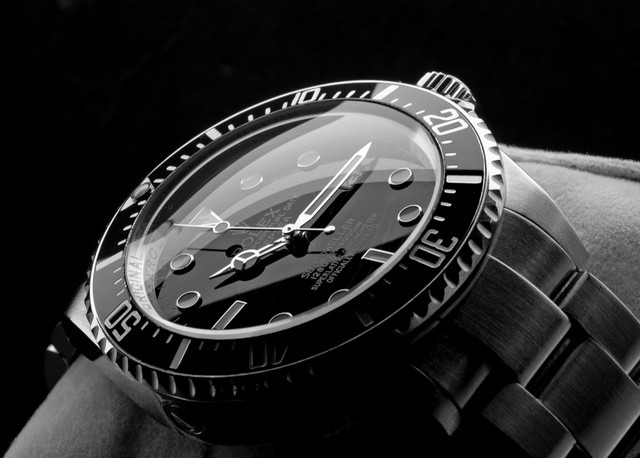
How waterproof should a watch be, really? The vast majority of us would never submerge our expensive timepiece in a bathtub, let alone take it for a swim in a swimming pool or (god forbid) the actual sea.
Despite that, many brands seem determined to push further the boundaries of how far into the depths of the earth one could hypothetically take their watch and reliably tell the time. A prime example of that is the Rolex Sea-Dweller. Created in 1967 under the name Oyster Perpetual Sea-Dweller, it was a watch designed solely to meet the expectations of prolonged underwater missions for saturation divers. Upon initial release, the watch (Reference 1665) boasted an impressive (even by today’s standards) 610 m (2,000 ft)—three times that of the regular Submariner.
Upon initial glance, the Rolex Sea-Dweller may look like an oversized, chunkier version of a Submariner. And for the vast majority of watch buyers, this assessment might be correct. But like with many things in life, the devil is in the details. Of all the customers who purchase dive watches, one out of fifty will take their deeper than 10 meters, which translates to approximately 3% of the capacity of the timepiece with 300-meter water resistance. The Sea-Dweller, on the other hand, can take you four times that depth and then some. Taking the same comparison with a Sea-Dweller, and you’re looking at less than 1% of the watch’s capability.
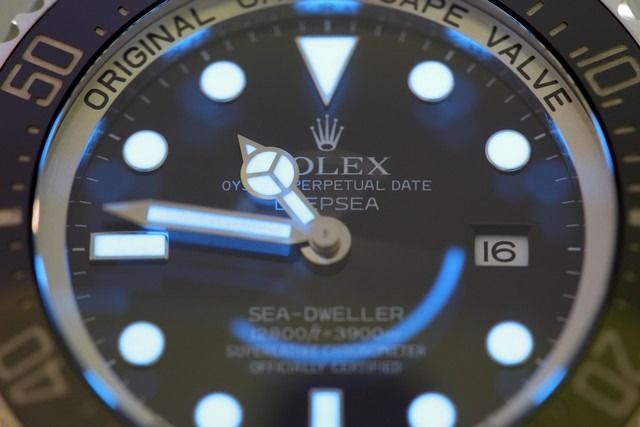 Additionally, what sets Sea-Dweller apart from the Submariner is the Helium Escape Valve, a feature that is crucial for saturation divers. The way high-depth diving works is as follows: the deeper you dive, the more your body requires a different mixture of gas. Due to rising pressures, breathing regular air is no longer safe, as nitrogen narcosis and oxygen toxicity pose serious risks. While your watch does not require gas to function, it is not immune to this type of extreme environment.
When submerged at great depths, helium particles can accumulate inside the case of the diving watch during prolonged exposure. During the decompression process, the trapped helium expands faster inside the case, which can cause the crystal to fail and damage the watch. The Helium Escape Valve fixes this by sensing the internal overpressure (usually 2-3 bar higher than outside) and opening automatically, allowing helium to escape without letting the water in.
The Watch that Breaks Boundaries: The Deepsea and the Spirit of Adventure
So, what is the point?
For all its technical brilliance, you’re still paying for a watch that’s about 30% thicker, heavier, and pricier than a Submariner—not exactly what the average wrist is after these days, especially with the trend toward smaller watches.
In a way, the answer to the question above came from Rolex itself. Bearing all these dilemmas in mind (answers to which only each of us can find for themselves), Rolex posed a different one: what if they went even deeper? In 2008, they introduced the Rolex Sea-Dweller Deepsea, capable of going 3,990 meters deep. Yes, that is almost 4 kilometres—a distance that some of us cover to go to work or a grocery store. Forget the practicality; there are only a handful of places on the whole planet that could cater to this feature and would allow its owner to fully experience it. And that is precisely what makes Sea-Dwellers so bloody awesome and why people go for it as opposed to more wearable pieces. The mere fact that they “could” be there with you, to the bottom of the world and back, withstanding the pressure of any environment you find yourself in.
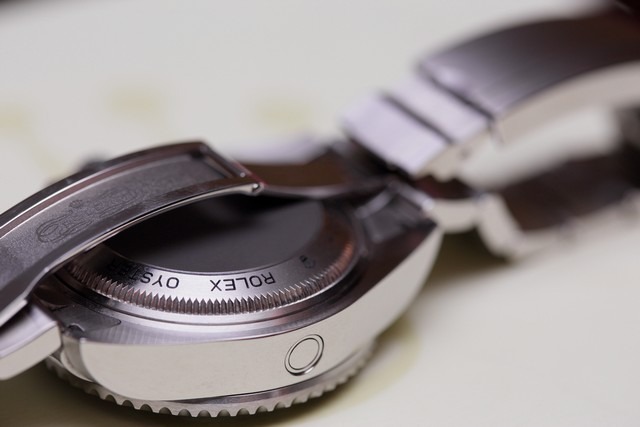 The Sea-Dweller is not one of Rolex’s most popular or best-selling products; in fact, far from it. The production volumes are one of the lowest in their lineup, while still being one of the most readily available watches, even on the current market. And that is perfectly fine. The Sea-Dweller, while being non-commercial, remains as important as any other watch in the Rolex catalogue. Catering to the professional clientele and staying true to its tool watch identity, it is the very watch with which Rolex can push the boundaries of what is possible, a notion that made their name in the 20th century.
How much is too much? It doesn’t matter. For now, the answers seem to lie within the Deepsea Challenge model, a hefty chunk of titanium with a 50 mm case and capable of going down 11,000 meters (36,090 ft). Tomorrow? Only time and Rolex will tell. As the advertisement poster back in the day proudly claimed: “If you were looking for lost empires here tomorrow, you’d wear a Rolex.” And while most of us probably never will, there is a certain kind of appeal and beauty in owning a piece that could.
By the same author:
A Pole in Space: Sławosz’s Odyssey
Resetting Omega: Charting a New Course with Old Compass
Source: quillandpad.com
Photo credit: felixmizioznikov via istockphoto.com; felixmizioznikov via istockphoto.com; ronen via istockphoto.com

A writer and analyst with a keen interest in the intersection of science, philosophy, and culture.