Les professionnels de GBNews.ch s'allient à la puissance des technologies en intelligence artificielle générative, pour informer la communauté des affaires et le grand public, des dernières tendances et des évolutions du marché de l'emploi.

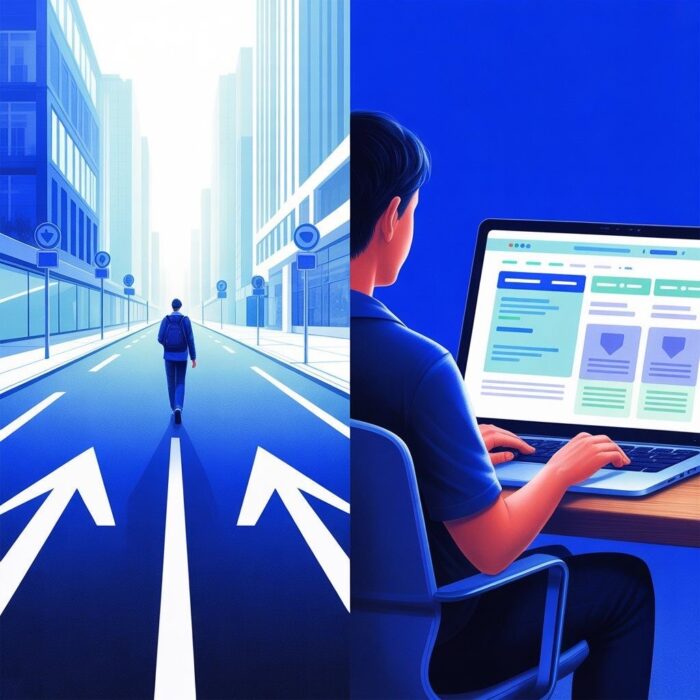
When we open a website, we rarely think why are some so easy and intuitive, while others feel chaotic?
In fact, these are the very same questions that architects face when they design cities.
Architecture is not only about buildings. It’s about creating spaces where people feel clear, comfortable, and at ease. And those very same principles also apply to website design.
In a city, we find our way thanks to road signs, maps in the subway, or directions at train stations.
In web design, menus, buttons, and headings play the same role. If they’re clear, it’s easy to get where you want to go. If not, it feels like being lost in an unfamiliar neighborhood without a map.
Cities have their own logic: there’s a center, residential areas, and industrial zones. Streets and blocks bring order to the space.
A website also has its own structure: a homepage, sections, and subpages. A clear organization makes the space understandable, even if it’s your first time visiting.
In a city, we orient ourselves by major, recognizable places — a square, a park, a shopping mall, or a train station. These become “landmarks” that help us navigate.
On a website, the same role is played by the logo, the homepage, or key buttons. They guide us further and help us stay orientated.
A city functions thanks to things we rarely think about: street lighting at night, sewage systems, or power lines underground. They’re invisible, but without them everything stops.
Websites have the same hidden elements: fast loading times, mobile responsiveness, stable performance. We don’t notice them when they work, but the moment they fail, the site turns into a “dark alley.”
Building facades, shop windows, parks, and squares create the atmosphere of a city and influence how we feel there.
In web design, colors, typography, and imagery play that role. A beautiful website, like a beautiful city, attracts us, inspires trust, and stays in memory.
Every city has elements we take for granted: crosswalks, traffic lights, street numbers. They’re the same everywhere because they’ve stood the test of time and are convenient for people.
In web design, there are also “timeless” solutions: the menu button in the top corner, blue underlined links, or contact information in the footer. They’ve become standards that make the space instantly understandable.
Both city architects and web designers share the same goal: to create a space where people feel comfortable, clear, and inspired to stay.
The only difference lies in the materials: one works with concrete and glass, the other with pixels and code.
A city lives in physical space, a website in the digital world. But both can become a home you want to return to.

Jeune professionnel du marketing et du design UI/UX, doté de solides compétences en conception web, je suis déterminé à mettre à profit et à développer mon expertise au sein d’un environnement dynamique.