
« L'effet Matrix » : L’évolution du rôle de l’expert en comptabilité et Payroll
« L’effet Matrix » : pourquoi l’expertise humaine reste essentielle en comptabilité et Payroll à l’ère de l’intelligence... En lire plus


Zurich, Switzerland - June 21, 2020: Shaking hands on the largest Swiss banknotes for 1000 francs
When payroll is mentioned, it is often associated with routine administrative work. People think of calculations, spreadsheets, and compliance checks. However, within the Swiss regulatory landscape—and especially in a high-density international hub like Geneva—this perception no longer reflects reality.
With over ten years of experience in HR and recruitment (mainly in Ukraine), I have always seen it as more than a transactional process. There, I learned that salary represents trust. Payroll reflects how reliably a company fulfils its obligations and how transparently it operates. In Switzerland, I am currently immersed in the learning and understanding of the local framework, and I am deeply impressed.
Maintaining this trust here requires navigating one of the most complex regulatory environments in the world.
It is important to recognize that the current precision of the Swiss system is the result of global technological progress. This transition from manual to digital is a worldwide phenomenon. A few years ago, payroll processes everywhere relied heavily on Excel spreadsheets, paper reports, and manual tax calculations, which carried a constant risk of human error.
Today, following international trends, payroll systems are increasingly integrated with ERP platforms and HR management systems. This global shift has transformed the payroll specialist’s role from a "calculator of wages" into a Process Architect.
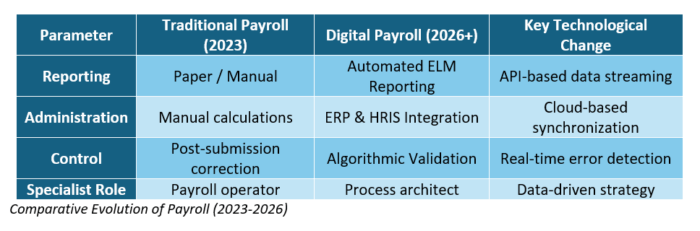
Switzerland has uniquely adapted global IT trends (Big Data, Cloud Computing) to create a national digital infrastructure.
For me, what stands out is that these systems are not just technical solutions but a coordinated national framework that ensures consistency, compliance, and trust among all stakeholders.
By 2026, two key instruments form the foundation of this system:
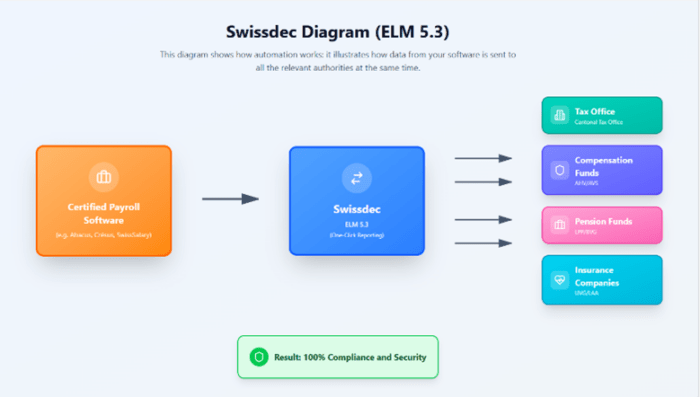
ELM effectively functions as the digital language of communication. If payroll data does not meet the standard, the system detects inconsistencies before submission, reducing compliance risks and administrative errors. For companies, this means fewer penalties, greater transparency, and a more efficient digital ecosystem.
For example, Geneva can be seen as a particularly compelling case for study and understanding modern payroll complexity.
Its large cross-border workforce, the presence of a cantonal minimum wage, and the concentration of international organizations create one of the most challenging payroll environments in Europe. In such conditions, payroll evolves beyond routine administration to become a strategic system that integrates regulation, technology, and social responsibility.
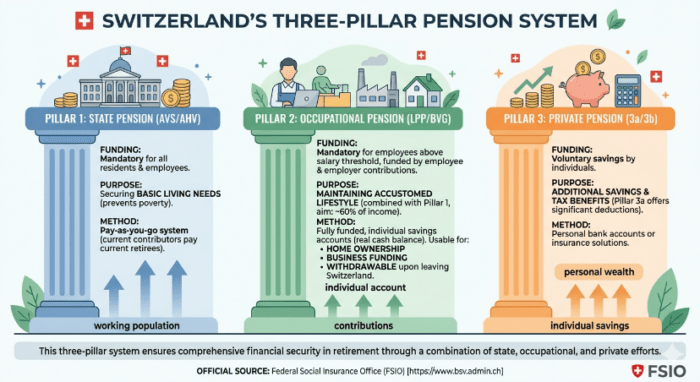
What makes this system particularly distinctive is the central role of Pillar 2.
From my perspective, what stands out is how this pillar transforms payroll contributions into directly measurable personal capital. Unlike traditional pension systems, it is not a future promise but a tangible, individually owned financial asset, with each employee holding a clearly defined and evolving balance.
Importantly, this capital is partially accessible under specific legal conditions—for example, for purchasing a primary residence, starting a business, or upon permanent departure from Switzerland. This turns pension savings into an active financial resource rather than a passive long-term reserve.
As a result, payroll contributions are linked not only to future pension entitlements but also to an individual’s current financial flexibility. This makes payroll accuracy critical.
Every contribution feeds into these systems—particularly Pillar 2. A miscalculation is not merely an accounting discrepancy; it has a direct impact on an employee’s personal capital. Unlike abstract tax adjustments, such discrepancies are visible, traceable, and often complex to correct retroactively.
Even small inconsistencies in reported salary components may affect accumulated pension capital over time—something I am currently exploring in more detail within the Swiss context. While negligible on a single payslip, their cumulative effect over the years can be significant. Conversely, overpayments may lead to administrative corrections and compliance risks for employers.
This leads to what can be described as “mathematical ethics.” Payroll is not only about compliance—it is about safeguarding individual wealth. Each payslip becomes a micro-level financial statement, where even minor inaccuracies carry tangible consequences.
Geneva adds another layer of complexity through its cantonal autonomy. It offers some of the highest family allowances in Switzerland and uses a highly detailed withholding tax system, shaped by its unique demographic structure—particularly its large population of cross-border workers.
A key example is the 40% teleworking threshold for employees residing in France. Exceeding this limit may shift both tax residency and social security obligations from Switzerland to France, requiring continuous monitoring and transforming payroll into a dynamic, risk-sensitive function.
Further layers arise from Geneva’s role as a global diplomatic hub. International organizations and permanent missions often operate under special legal frameworks, including tax exemptions, alternative social security arrangements, and, in some cases, multi-currency payroll structures. This requires precise financial coordination across jurisdictions.
The integration of Swissdec, ELM, and modern payroll platforms allows organizations to effectively manage this complexity.
Swissdec certification and the ELM (Electronic Salary Reporting) standard ensure unified, secure communication between companies, tax authorities, social insurance institutions, and pension funds. At the operational level, platforms such as Abacus, SwissSalary, Crésus, and Bexio provide integrated solutions for payroll processing and employee data management.
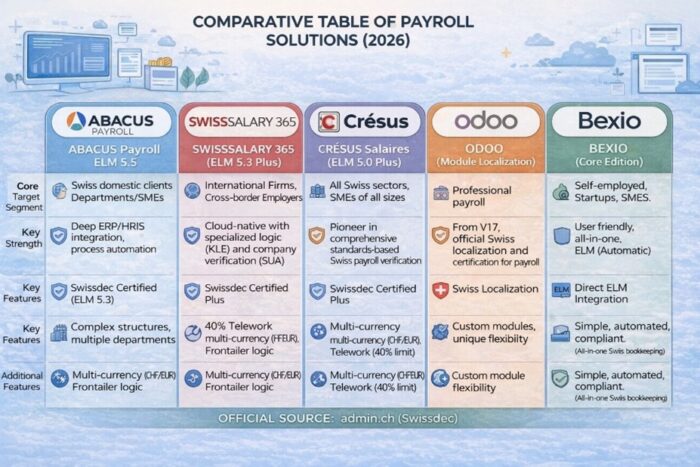
These platforms often include Employee Self-Service (ESS) portals, allowing employees to access payslips, tax certificates, and personal data independently. This enhances transparency, reduces administrative workload, and enables HR teams to focus on more strategic tasks.
As payroll systems become fully digital, data protection becomes a central concern. In Switzerland, its protection is governed by the nFADP (New Federal Act on Data Protection) and is built upon:
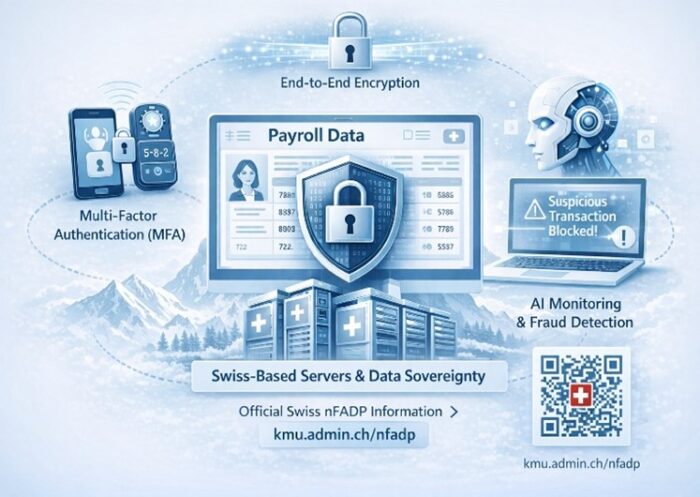
Switzerland’s payroll system demonstrates a profound transformation. What was once a routine back-office task has become a strategic foundation of economic stability. This change is not just about local laws, but about how Switzerland has successfully harnessed global technological progress to serve human values.
Thanks to Swissdec standards and ELM technology, payroll has evolved into an intelligent ecosystem where complex tax calculations and compliance processes are fully automated. By 2026, payroll stands at the intersection of technology and ethics. It is not just numbers in a system; it is a reliable mechanism that ensures every franc is accounted for and every employee's future is secure.
Payroll is no longer a support function. It has become a core pillar of economic trust and long-term stability in the Swiss model of success. It is the ultimate expression of how global innovation can be localized to create a culture of absolute precision.
Sources:
https://www.swissdec.ch/ The official body defining the unified standards for electronic data exchange between companies, tax authorities, and social insurance institutions.
https://www.swissdec.ch/en/standards/elm/ Detailed technical specifications of the «Einheitliches Lohnmeldeverfahren» used for mandatory electronic reporting.
https://www.bsv.admin.ch/ The central authority for the three-pillar system, including OASI/AHV and disability insurance.
https://www.admin.ch/opc/en/classified-compilation/19820377/index.html The full legislative text governing the second pillar of the Swiss pension system.
Taxation & Geneva Specifics https://www.estv.admin.ch/estv/en/home/direkte- bundessteuer/fachinformationen/quellensteuer.html
Geneva Cantonal Tax Administration (ACD) https://www.ge.ch/en/taxation Official guidance on cantonal tax obligations, specific to the Geneva region and cross-border workers.
Geneva Minimum Wage (Salaire Minimum) https://www.ge.ch/salaire-minimum
State Secretariat for Economic Affairs (SECO) - Labour Law https://www.seco.admin.ch/seco/en/home/Arbeit/Arbeitsrecht.html Information on the Swiss Code of Obligations, work hours, and employment contracts.
https://www.fedlex.admin.ch/eli/cc/2022/491/en The official text of the New Federal Act on Data Protection, which governs the privacy of employee data.
Federal Data Protection and Information Commissioner (FDPIC) https://www.edoeb.admin.ch/ Guidance on privacy compliance for businesses operating within Switzerland.
Image: taldav68 via DepositPhotos

Finance graduate with strong knowledge of the Swiss finance and accounting landscape, focusing on developing expertise in payroll and Swiss social insurance systems.


Suppose a small service business records a bank-detail change with a unique ID, but the employee making it redirects a salary payment without permission. The audit trail would help trace the change, yet the payment could still reach the wrong account. That hypothetical makes the article’s fraud-prevention assertion seem stronger than the logging mechanism alone supports.