Les professionnels de GBNews.ch s'allient à la puissance des technologies en intelligence artificielle générative, pour informer la communauté des affaires et le grand public, des dernières tendances et des évolutions du marché de l'emploi.

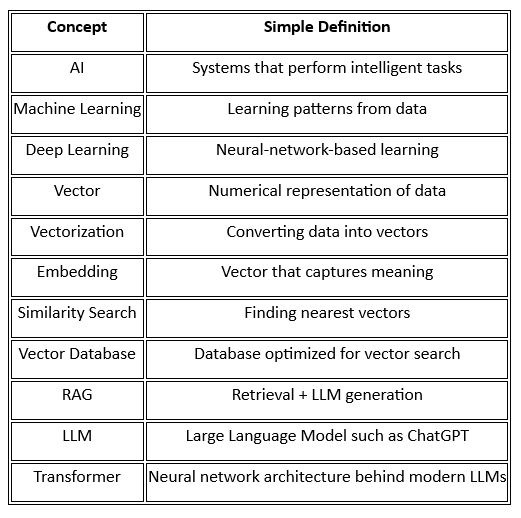
Artificial Intelligence (AI) is the field of building systems that can perform tasks that normally require human intelligence, such as understanding language, recognising images, making predictions, solving problems, and generating text, code, music, or images.
I started using AI in my work as a software developer. AI is an incredible tool that can help you become more productive when designing code, creating design elements, or analysing business problems.
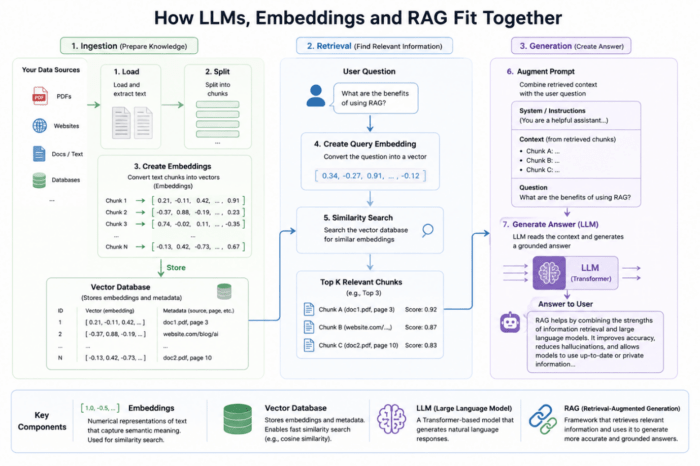
Below is a diagram showing how LLMs, embeddings, and RAG fit together. It presents seven steps: 1. Load, 2. Split, 3. Create Embeddings, 4. Create Query Embedding, 5. Similarity Search, 6. Augment Prompt, and 7. Generate Answer. Some useful definitions related to AI are provided further down.
Modern AI is largely based on Machine Learning (ML), where computers learn patterns from data instead of being explicitly programmed. Deep Learning is a branch of Machine Learning that uses artificial neural networks with many layers ("deep" networks) to learn patterns from data.
Transformers are a neural network architecture behind modern LLMs. A type of deep learning architecture designed to process sequences of data, especially language. They are the foundation of most modern AI systems, such as ChatGPT, Gemini or Claude. Transformers introduce an efficient approach that allows models to look at all words in a sentence simultaneously.
An LLM is an AI model trained on massive amounts of text to understand and generate human language. It can answer questions, write essays, summarize documents, translate languages, generate code, and hold conversations. Examples include ChatGPT, Claude, Gemini, and Llama.
An AI model learns from large amounts of data. After seeing billions of examples, the model learns statistical relationships between words. AI does not "understand" like humans; it learns patterns that allow it to make useful predictions.
We explain below key concepts such as vectorization, embeddings, vector databases, similarity search and LLMs.
What is Vectorization?
Computers cannot directly understand words. Data is converted into numerical representations with some encoding. An example of encoding could be Dog = [1,0,0], Cat = [0,1,0], Car = [0,0,1].
This conversion process is called vectorization. Everything in AI eventually becomes vectors.
What are Embeddings?
Basic vectorization treats words as unrelated. Embeddings are smarter. They convert words, sentences, documents, images, or products into vectors that capture meaning.
Distance between vectors reflects semantic similarity. This allows AI to understand similar meanings, related concepts, and context.
Embedding Models
An embedding model converts text into vectors. An embedding typically carries many dimensions, from a few hundred to thousands of dimensions, to capture the complexity of the language (topics, sentiment, context, relationships, grammar, etc.). OpenAI, Google, and many open-source models provide embedding models.
Vector Databases
Once documents are converted into embeddings, we store them in a database. Popular vector databases include Pinecone, Weaviate, Milvus, and Qdrant.
They are optimized for similarity search.
Similarity Search
Suppose we store documents. Each document becomes an embedding.
User asks: "How do neural networks learn?" The query is converted into an embedding, and we then calculate similarities with documents. The system retrieves the document with the closest similarity.
This is the foundation of Retrieval-Augmented Generation (RAG). RAG combines search and a large language model (LLM). Instead of relying only on what the model learned during training, the system first retrieves relevant information. The steps involved in answering an end user’s question include: converting the question into an embedding, searching a vector database to retrieve relevant documents, and providing those documents to the LLM. The model then receives relevant context before generating an answer.
The Role of LLMs
Modern systems like ChatGPT are based on transformers, a deep learning architecture.
When you ask a question, a RAG system may do: 1. User question, 2. Create embedding, 3. Search vector DB, 4. Retrieve documents, 5. Send context + question to LLM, 6. Generate answer.
Conclusion
AI is a powerful tool that can help people become more productive, and its impact can be positive when it is used responsibly. Its benefits, including efficiency, accuracy, and innovation, are significant. However, challenges such as its impact on employment, bias, privacy, and security must be addressed to ensure that AI benefits society.
For example, AI can automate tasks that were previously performed by humans, creating uncertainty and pressure in the labour market.
AI also relies on large amounts of personal data, including information about online activity, location, purchasing habits, and even biometric data. If this information is collected or used without appropriate safeguards, it can reduce people’s privacy and increase the risks associated with its use.
As a software developer, AI helps me build better code, and my short-term objective is to develop a chatbot for a website. A chatbot generally consists of a front end and a back end that send user messages to an LLM. It may also use RAG, combining embeddings with a vector database, so that the LLM can answer questions using company documents.
Small models that can run a chatbot on a laptop or small server include Phi and Gemma. A typical starter stack might use a Qwen or Llama model together with embeddings and a vector database such as Qdrant.
Image: Depositphotos

Bringing value to organisations through my broad software development skills.