The Hitchhiker's Guide to the AI Galaxy
OpenAI has signed nearly $1 trillion in circular deals with tech giants like Oracle, Nvidia, and AMD to... En lire plus


AI tools have become essential in administration and executive assistance roles through enhancing efficiency, accuracy, and productivity.
These roles often involve managing large volumes of information, coordinating schedules, preparing documents, and handling multiple responsibilities at once. AI-powered solutions help streamline such tasks by automating repetitive processes, reducing manual workload, and allowing assistants to focus on higher-value support and strategic coordination.
In executive assistance, where responsiveness and time management are critical, AI tools play an increasingly important role in optimizing daily operations. Smart scheduling systems, automated meeting summaries, document drafting tools, and workflow platforms help executives stay organized while ensuring that communications and priorities are addressed promptly. This enables executive assistants to anticipate needs more effectively and provide faster, more informed support in complex environments.
Moreover, AI tools contribute to stronger professionalism and decision-making by improving data management, enhancing communication, and ensuring reliable follow-up systems. They assist with organizing records, tracking expenses, managing travel logistics, and even supporting multilingual communication through translation features. As organizations continue to embrace digital transformation, proficiency in AI tools has become a valuable asset for administrative and executive professionals seeking to remain adaptable and competitive.
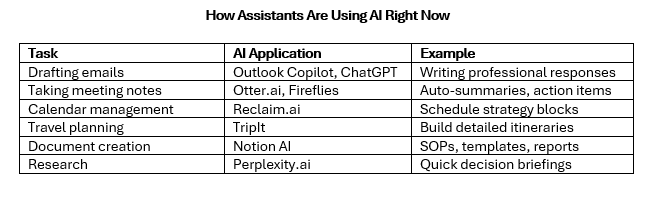
Here’s a practical overview of AI tools that are especially useful for administrative and executive assistants today grouped by function so you can see which tools help with specific tasks (2026).
AI tools here automate invitations, scheduling, reminders, and conflicts.
Scheduling & Agenda Assistants
Benefits: Saves hours of back-and-forth emails, avoids double-booking, handles rescheduling.
These help you draft, summarize, prioritize, or respond to emails.
Email AI Assistants
Benefits: Faster replies, consistent tone, adapt language to context (formal, casual, concise).
For creating presentations, letters, reports, and policies.
Writing & Editing
Benefits: Elevates quality, saves drafting time, and ensures professionalism.
These tools record meetings and turn them into structured notes.
Meeting AI Assistants
Benefits: Saves manual minutes, creates accurate follow-ups, and captures key decisions.
Tools that organize information and make it searchable.
Smart Document Helpers
Benefits: Centralized reference hub, searchable notes, auto-tagging.
AI platforms that optimize travel plans and itineraries.
Travel Assistants
Benefits: Smooth travel planning, real-time updates, visa/entry assistance.
AI + automation platforms that reduce manual work.
Workflow Automation
Benefits: Reduces repetitive tasks, integrates tools without coding.
Fast, AI-assisted information gathering and briefing.
Research Assistants
Benefits: Quick background checks, briefing notes, fact-checking, executive summaries.
Tools that ensure privacy and compliance for sensitive data.
Secure AI Platforms
Benefits: Confidential handling, suitable for executive/corporate environments.
AI can draft; you review and personalize.
Tone and nuance matter.
For sensitive CEO data, use secure enterprise AI, not public chat apps.
Well-written prompts = better outputs.
Example: “Draft a meeting email confirming location, objectives, and deliverables.”
Store AI-generated templates for:

AI tools are now powerful allies in modern administration, helping professionals work smarter and more efficiently. They save valuable hours by streamlining email management and scheduling, capturing accurate meeting insights, and transforming rough notes into polished documents. AI can also automate task tracking and workflow management, while quickly preparing research briefs that support informed decision-making. In short, these tools amplify effectiveness, reduce operational friction, and free up time to focus on higher-level responsibilities that add real value to executives and organizations.
AI tools have transformed administration and executive assistance by automating routine tasks such as scheduling, document drafting, data organization, and communication support. In many workplaces, AI can now handle repetitive duties faster than humans, improving efficiency and reducing operational costs. As a result, certain predictable aspects of administrative work may become increasingly automated.
However, AI tools are unlikely to completely replace human executive assistants because the role extends far beyond technical execution. Executive support requires emotional intelligence, judgment, discretion, and interpersonal skills — qualities that AI cannot truly replicate. Assistants often manage sensitive relationships, understand organizational dynamics, anticipate executive needs, and handle complex situations that require diplomacy and human intuition.
In addition, executive assistants play a critical role in adapting to unexpected changes, supporting decision-making, and maintaining trust in confidential matters. AI can automate processes and provide suggestions, but it cannot fully understand human priorities, cultural sensitivities, or accountability in the same way a skilled professional can. In sectors such as diplomacy, private banking, or international organizations, confidentiality and human oversight remain essential.
Ultimately, AI is best viewed as a powerful tool that enhances the work of administrative professionals rather than replacing them. The future of administration and executive assistance will likely involve collaboration between humans and AI: professionals who embrace technology will become even more valuable by combining efficiency with strategic thinking, communication skills, and human-centered support.
Images: Depositphotos 1 & Depositphotos 2

An experienced administrative professional with a strong track record of supporting senior leadership in international environments.