L’agriculture moderne est-elle apte à affronter l’avenir ?
La révolution verte est la transformation de l’agriculture à partir de 1945 dans les pays industrialisés ainsi que... En lire plus

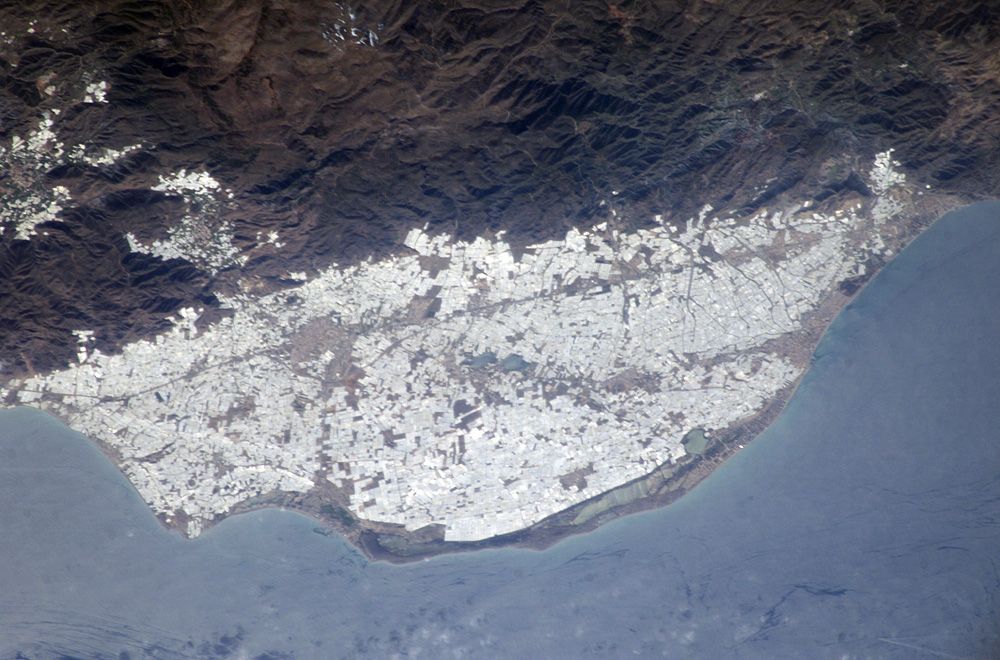
Picture: "Thousands of greenhouses extending from the coastline right up to the base of the mountains, Almeria, Spain”
Tomatoes, aubergines and bell peppers all year round, and the first strawberries of the year in March: this is reality in our supermarkets. But where do these fruits and vegetables come from, and how are they produced?
One of the most important regions in Europe for fruit and vegetable production is the region of Almeria in South-eastern Spain. Around 40,000 ha of the area in this region are covered with greenhouses. In 2014, 2.4 million tons of fruit and vegetables produced in the Almeria region were exported, amounting to about 2.13 million € or 73% of the total export from the province and accounting for about 40% of Spain’s exports of fruit and vegetables. The main buyers of fruits and vegetables from Almeria are other countries of the European Union, however, Switzerland also imports from the region mainly in the winter season.
The climate in Almeria is dry and hot, with only 200 mm of rain per year on average. The province lies on a large groundwater reservoir, which, due to the lack of surface water resources, has been used for irrigation of the plants in the greenhouses since the 1970s. This extensive use of groundwater in the past has caused lowering of the groundwater table, leading to increased salinity of the groundwater and the desiccation of soil layers. In areas close to the shore, salinization is even stronger through intrusion of marine water. Ground subsidence has also been observed in the region, which is another consequence of pumping out groundwater for irrigation of the greenhouses.
Today, water usage is regulated and advances in irrigation techniques, such as the use of dripping systems, have drastically reduced the amount of water being used. Also, alternatives have successfully been identified, such as regenerated urban wastewater (which is disinfected before being used for irrigation) or desalinated sea water, which are now both frequently used as an alternative for groundwater.
Soil is as scarce as water in Almeria. Nowadays, the vegetables are mainly produced in hydroponic systems which use substrates such as perlite or rock wool for plant growth. However, in the beginnings of vegetable production in Almeria, farmers deposited thin layers of artificial soils in the greenhouses to grow the crops. These soils were made up of silt and clay that were extracted from large clay pits in the region and mixed with fertilizers. About 8 million m³ of silt and clay were extracted from the local pits, some of which were later abandoned.
The runoff of surface water from storm events and interaction with the groundwater table lying very close to the surface have led to the formation of artificial wetlands in those former pits, which have created new issues in the region. On the one hand, wetlands should be protected as they are important water resources and biotopes for many species which are threatened by increased input of fertilizers from the nearby horticultural land. On the other hand, these artificial wetlands represent serious risks of flooding the surrounding area, threatening not only people living in the region, but also their property and the land used for vegetable production.
For many years, fruits and vegetables from the Almeria region had a bad reputation because of repeated detection of pesticide residues above the maximum permissible values, as well as the use of unauthorized substances. However, these alerts led the public authorities to react, which caused an important change in the practices used nowadays. The techniques used to control diseases and pests have changed, in large part, from chemical to integrated and biological control. This includes the use of organisms, such as predators or parasites, for fighting against pests and diseases. The change has been implemented quite quickly: the biologically-controlled area in Southern Spain grew from 1,400 ha in 2007 to more than 26,000 ha in 2014, and the overall use of pesticides has been drastically reduced.
The form of horticulture in Almeria, however, also has advantages. The production costs are lower than those in the Netherlands, for example, which are also among the most important vegetable producers in Europe. One reason is the greenhouses themselves. Those in the Netherlands are made from glass and generally more sophisticated, whereas the plastic greenhouses in Almeria are cheaper and sometimes even homemade. Two considerable advantages of the Almeria region are the good light conditions and the very low energy costs. Dutch greenhouses, where supplemental light and heating is necessary especially in winter, are energy-intensive. In Almeria, the greenhouses sometimes even need to be shaded by using white foil in order to prevent overheating.
Overall, the fruit and vegetables from large-scale greenhouse production systems in Europe are generally of good quality, and their prices are more competitive than those of regionally produced, seasonal fruits and vegetables. Each customer therefore has to decide whether he or she prefers to buy cheap tomatoes all year round, or whether he prefers regional products which are available only during the season.
Sources:
Almeria's agricultural exports up 50% in 10 years. Agridesk, March 17 2015.
Competitiveness of the Spanish and Dutch Greenhouse Industries with the Florida Fresh Vegetable Industry, Daniel J. Cantliffe, John J. Vansickle, EDIS, UF/IFAS Extension, HS918, one of a series of the Horticultural Sciences Department, Florida Cooperative Extension Service, Institute of Food and
Agricultural Sciences, University of Florida. Original publication date May 2003. Revised July 2009. Reviewed August 2012.
Contreras J.I., Eymar E., Lopez J.G., Lao M.T., Segura M.L. (2013) Influences of Nitrogen and Potassium Fertigation on Nutrient Uptake, Production, and Quality of Pepper Irrigated with Disinfected Urban Wastewater. Communications in Soil Science and Plant Analysis 44, 767–775
Lozano R., Fernando Diánez F., Camacho F. (2010) Evolution of the phytosanitary control system in the intensive horticulture model of high yield in Almería (2005-2008). Journal of Food, Agriculture & Environment 8, 330-338
Molina-Sanchez L., Sanchez-Martos F., Daniele L., Vallejos A., Pulido-Bosch A. (2015) Interaction of aquifer–wetland in a zone of intensive agriculture: the case of Campo de Dalias (Almeria, SE Spain). Environmental Earth Sciences 73, 2869-2880
Pulido-Bosch A., Delgado J., Sola F., Vallejos A., Vicente F., Lopez-Sanchez J.M., Mallorqui J.J. (2012) Identification of potential subsidence related to pumping in the Almeria basin (SE Spain). Hydrological Processes 26, 731-740
Sanchez C., Gallego J.R., Gamez M., Cabello T. (2014) Intensive Biological Control in Spanish Greenhouses: Problems of the Success. International Journal of Biological, Food, Veterinary and Agricultural Engineering 8.
Photo credit: Earth Science and Remote Sensing Unit, NASA Johnson Space Center
It is good to learn that vegetable and fruit production in Southern Spain is now less detrimental to the environment and that food safety issues are being addressed.
As Eduard says, the environmental cost of actually growing the fruit and vegetables has been reduced, but what about the environmental cost of transporting the produce to its markets?
I would also like to ask another question - with all the plant research going on, GMO and otherwise, can fruit and vegetables which naturally require specific conditions, such as high temperatures/ a sunny climate, be grown in more temperate climates without the need for heating? Are there fruits/vegetables which exist which have been modified to require less water to produce the same yield without any noticeable difference to the consumer?
Interesting article, I didn't know that after all the criticism the region of Almeria changed its policies towards the environment. But what about the very bad working conditions of many North-African workers working in these fields ? Is there any change in this area ?