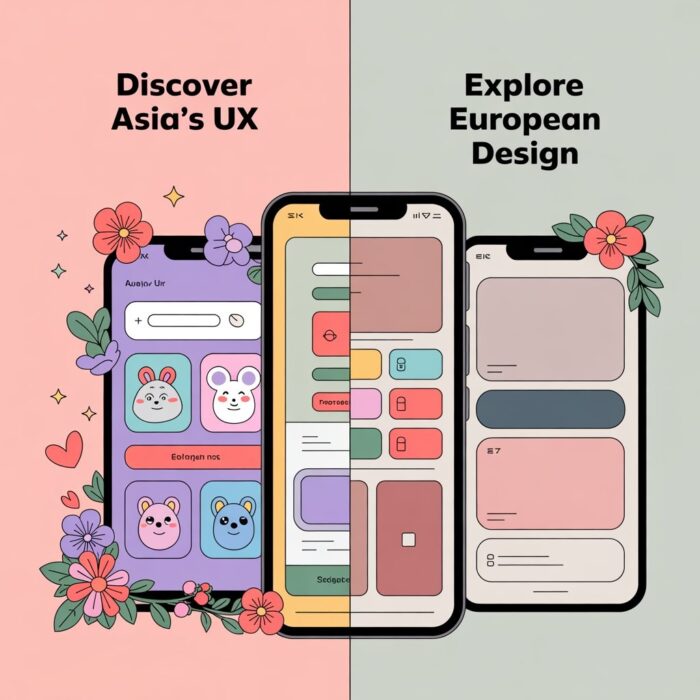
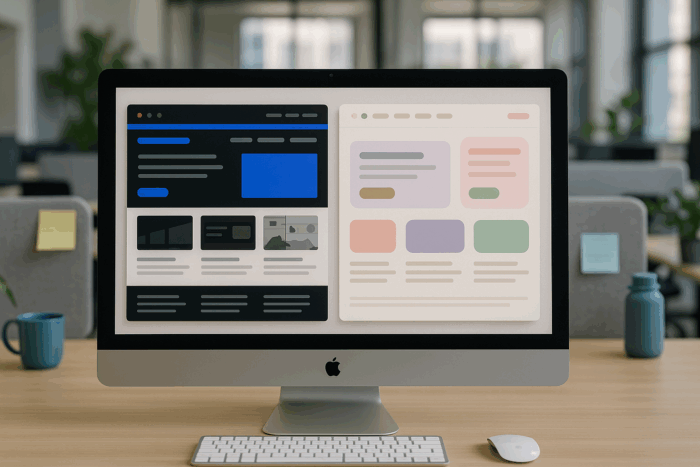
Le design au-delà du titre : développer grâce à l’IA, à la stratégie et à la transition
Si l’intelligence artificielle peut générer des mises en page, des textes et des concepts visuels en quelques secondes,... En lire plus

Why does modern design lean towards feminine curves, and how do feminine-coded aesthetics (representing traits often labelled as 'feminine' in design, like curved shapes, soft tones, and relational flow) impact your digital experience and moderate your online behavior?
Have you noticed that the design of business areas or promotional zones often emphasizes minimalism, efficiency, and logic—traits traditionally associated with masculinity?
Yet, if we shift toward softness, emotion, and relational thinking, we receive parks and pastel coffee shops?
In this article, you will learn how these gender-coded elements work (using specific colors, shapes, materials, or other design elements that are traditionally associated with masculinity or femininity), when and why they affect our perception, feelings, and choices, and understand what “design feminization” is and why we need it more than ever.
Over the last century, the influence of feminism has become stronger and influential. Women began working alongside men, wearing clothes and taking spaces that were once only for men. As technology progressed, the world started moving faster - efficiency, strength, individualism, and assertiveness became the main priorities.
Since then, across Europe—including Switzerland—there has been a clear tendency to tone down feminine expression. In fashion and office culture, women are often expected to adopt a more masculine style: angular suits, cropped or tight hairstyles, little or no makeup, and loose clothing to hide the body’s natural curves.
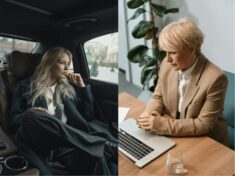 The result is a quiet suppression of traditional femininity and a new ideal for females in society. Being girly was seen as childish. Openly showing your frustration was unprofessional and over-sensitive – immature even. It reflects a culture that prioritizes restraint, formality, and structure over softness, beauty, and emotional expression.
Yes, modern feminism has given women access to traditionally male spaces, but more often than not, by encouraging women to act more like men. Instead of reshaping systems to reflect women’s unique rhythms and needs, success is still measured by masculine standards—competitive, rigid, and performance-driven.
This overlooks women's biological and emotional differences, and sidelines femininity rather than embracing it. At the same time, society misinterprets feminine expression as performance for male attention rather than an authentic embodiment of self. True femininity is not about mimicry or appeal; it’s about presence, care, and emotional richness. Reclaiming it means honoring femininity as powerful in its own right, not something to suppress or exaggerate.
Just as modern feminism asks women to succeed by becoming more like men, the digital world follows a similar pattern. Since the invention of the internet — an area traditionally seen as a man’s space, especially in IT, development, and even web design—digital spaces were built around masculine values and ways of thinking: angular layouts, straightforward flows, fast-paced interactions, aggressive pop-ups and buttons, and pushy CTAs.
But in today’s world, people are tired. Life outside the screen is already fast and overwhelming—digital spaces have started to play a different role—we rest there, express our personality, spend time with friends, journal, and create. Most of our lives happen online now. So, we need something different.
Apps and websites can’t feel like survival zones anymore. They need to feel more like homes—places where we feel safe, seen, and supported. It’s time for a shift in UX and UI, toward softer, slower, more emotionally aware spaces.
Not to make them "feminine" in a cliché way, but to bring in more maternal qualities like warmth, care, and beauty—things the digital world has been missing for too long.
In my next article to come, “Feminine UX Design: Psychology of Emotions”, you will find out how simple principles of feminine design impact everything in the app/web – from user journey to conversion rate.
Sources:
Forbes/ The Rise Of Office Core: A Symbol Of Power At Copenhagen Fashion Week
Vogue Business/ From tradwives to bullet bras: How should fashion engage with womanhood in 2025?
Style Rave/Genderless Fashion: A Revolutionary Shift In Style And Expression
Photo credit: MART PRODUCTION - Photographie via pexel.com; Tima Miroshnichenko - Photography via pexels.com

Mariia Kalinicheva | UX & CRO specialist with a passion for storytelling, UI and HTML