From the Dojo to Management: The Karate Compass for Leadership in Times of Crisis
Discover how the principles of Shotokan Karate guided a business leader through a major supply chain crisis, turning... En lire plus

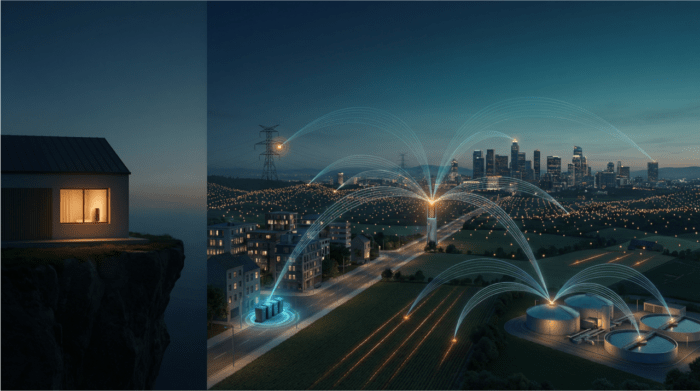
Imagine you and your friends are spread across a huge neighbourhood and need to communicate. You try everything:
Shouting — exhausting and doesn't reach very far. Tin can telephones with string — they work, but imagine stretching wires across the entire neighbourhood. Walkie-talkies — great, but the batteries die in hours, and they're expensive. Cell phones — perfect, but what if there's no signal? And each one needs a costly monthly data plan.
No solution is perfect, right? For decades, the technology world faced the exact same dilemma, trying to make "things" — like soil moisture sensors on a farm, smart trash bins in a city, or water meters in buildings — "talk" to the internet. They needed a way to send small messages, from very far away, using almost no battery, and without costing a fortune.
Then, a technology with a name that sounds like a superhero appeared: LoRa. And it completely changed the rules of the game.
Before LoRa, the solutions were like the examples above. Telemetry — the technical name for this long-distance communication — relied either on the "brute force" of powerful radios that consumed enormous amounts of energy, or on the expensive dependency of cellular networks. Monitoring thousands of points was a logistical and financial nightmare.
LoRa brought a different approach, based on a principle that nature has been using for a very long time. Think about how bats and dolphins navigate: they emit a quiet sound, a "chirp," that travels far and bounces back, allowing them to map their environment. LoRa does something similar with radio waves. Its modulation, called Chirp Spread Spectrum (CSS), is like an intelligent whisper [1]. Instead of shouting (using high power), it spreads the message in a unique way that makes it incredibly resistant to noise.
And here's the really clever part: only another bat or dolphin can decipher that signal. To other animals, it's just random noise. This is a form of natural cryptography. LoRa works the same way: the signal appears as background noise to any conventional receiver, but a LoRa device, knowing the "secret language" of the chirp, can decode it perfectly. This way, a sensor can send information for miles using the same energy as a TV remote control.
"LoRa did not invent wireless communication. It reinvented it for a world with billions of devices, making the impossible, trivial."
When we hear "IoT," we often think of smart homes — turning on lights with our voice or seeing who's at the door through our phone. But that's just the tip of the iceberg. The true revolution of LoRa is in industrial telemetry, where the challenges are much greater, and the impact is enormous.
Imagine a major electric utility company needing to monitor its vast transmission network. Before LoRa, this was a monumental task. Now, as you rightly pointed out, LoRa sensors can be installed on high-voltage towers in remote locations to monitor everything from cable temperature and vibration to tower inclination [2]. These sensors run on batteries for years and send critical alerts that prevent blackouts, without needing a cellular signal or a power outlet.
Or consider your suggestion for smart waste management. It's not just a concept; it's a reality. Cities like Lisbon are already using LoRa sensors in trash bins to report when they are full [3]. This allows garbage collection trucks to receive real-time alerts and optimise their routes, collecting only from full bins. The results are impressive: some cities have seen a 31% reduction in CO2 emissions from their collection fleet [4] and up to a 60% reduction in operational costs [5]. This is the real power of LoRa: solving large-scale, real-world problems.
What makes LoRa so revolutionary can be summarised in three "superpowers" that solve the old problems of telemetry:
Superpower 1 — Batteries That Last Years, Not Months. Thanks to its "intelligent whisper" communication, a LoRa device can run on a single battery for 5, 10, or even 15 years [6]. This allows you to install sensors in remote locations and simply forget about them, knowing they will keep working. A conventional VHF/UHF radio transmitting the same small data packet consumes hundreds of milliamps to watts of power. LoRa, thanks to CSS modulation, transmits the same information with far less power and still achieves equal or greater distances. The conventional radio needs brute force to overcome noise; LoRa uses intelligence in its modulation.
Superpower 2 — Near-Zero Operating Cost. Unlike cellular, which requires a SIM card and a monthly subscription for each device, LoRa operates on license-free radio frequencies. Once you install your own communication gateways, there are no recurring costs. If you have 1,000 sensors, that means 1,000 SIM cards with monthly fees using cellular. With LoRa, you install your own gateways and pay nothing to anyone. With over 125 million devices already deployed worldwide [7], the savings are massive.
Superpower 3 — Massive Scale, Made Simple. A single LoRa gateway can "listen" to the whispers of thousands of sensors simultaneously, across a radius of several kilometres. This made it viable to create enormous networks for smart cities (monitoring waste and traffic), connected farms (optimising water use by up to 30% [8]), and Industry 4.0 factories. With conventional radio, each channel supports only a few devices due to collision problems. With cables, each point means a new physical installation. LoRaWAN solves this with its media access protocol, device classes, and automatic data rate management.
To make the comparison crystal clear, here is how LoRa stacks up against the older technologies across every critical dimension:
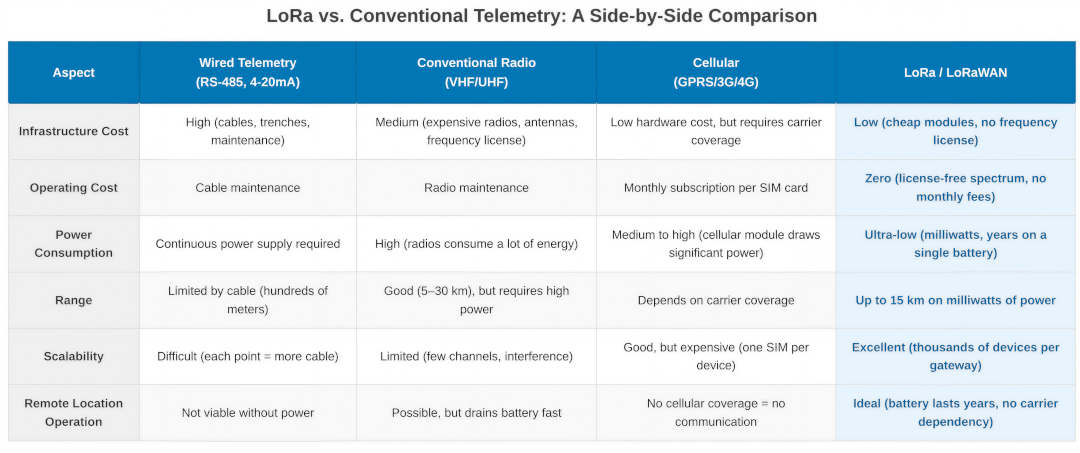
The true differentiator of LoRa was not merely the creation of yet another wireless communication standard. It was unlocking the potential of the Internet of Things (IoT) at a scale once considered pure science fiction. Before LoRa, monitoring soil moisture at 500 points on a remote farm, running on batteries, with no monthly cost, was impossible. Today, with LoRa, it is a reality that helps feed the world more efficiently.
LoRa teaches us a valuable lesson that goes far beyond technology: sometimes, the most powerful solution is not the one that shouts the loudest, but the one that whispers with the most intelligence.
What about you — have you ever imagined what kind of "thing" you would like to connect to the internet to solve a problem at your workplace or in your city? I would love to read your ideas in the comments.
#IoT #LoRa #LoRaWAN #Technology #Innovation #DigitalTransformation #SmartCities #AgroTech #Industry40 #SupplyChain #Engineering #SmartGrid #WasteManagement
References
[1] The Things Network, "What are LoRa and LoRaWAN?" - https://www.thethingsnetwork.org/docs/lorawan/what-is-lorawan/ [2] Fourfaith, "LoRa & Line-to-Line Electricity Transmission Monitoring Applications" - https://www.fourfaith.com/loraapplications/lora-line-to-line-electricity-transmission-monitoring-applications.html [3] National Center for Biotechnology Information (NCBI), "LoRaWAN and Urban Waste Management—A Trial" - https://pmc.ncbi.nlm.nih.gov/articles/PMC8003211/ [4] X-Telia, "Smart trash can sensors: reducing municipal GHG emissions" - https://en.x-telia.com/news/reduction-des-ges-municipaux-graces-aux-capteurs-de-poubelles [5] CORDIS | European Commission, "Unique smart waste management solution delivering 60% reduction on CO2 emissions..." - https://cordis.europa.eu/project/id/101010676 [6] Milesight, "LoRaWAN Temperature and Humidity Sensor" - https://www.milesight.com/iot/temperature-and-humidity-sensor [7] LoRa Alliance, "LoRa Alliance® Reports 125 Million LoRaWAN® End Devices Deployed Globally" - https://resources.lora-alliance.org/home/lora-alliance-reports-125-million-lorawan-end-devices-deployed-globally [8] Semtech, "IoT Applications for Smart Agriculture with LoRa® Technology" - https://www.semtech.com/lora/lora-applications/smart-agriculture
Image: AI-generated using Manus AI (https://manus.im).

I turn critical telecom infrastructure into competitive advantages for my clients. 15 years of expertise: from DWDM/SDH/PTP radios backbone networks to 5G deployment, coordinating 1,000+ field resources. My approach? Technical excellence meets entrepreneurial vision to deliver high-impact projects—on time, on budget, with added value. Based in Geneva, seeking the next major telecommunications challenge in Switzerland or Europe.