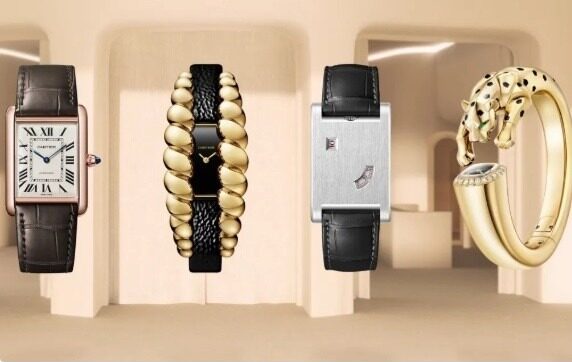
Watches and Wonders 2025: Cartier, l’esprit de la forme sublimé
Cartier a une nouvelle fois captivé l’attention en dévoilant un éventail de créations à travers ses collections emblématiques.


When you think about Omega, what do you see?
If, like me, you grew up watching James Bond in the 2000s, then you may recall the escapades of 007- Images of Pierce Brosnan and Daniel Craig deploying a laser from Omega Seamaster's crown or using the bezel to detonate explosives.
Suppose action films are not your thing, or you come from a generation before me. In that case, chances are you will think of the iconic Omega Speedmaster, also known as the "Moonwatch" - perhaps the most important chronograph ever made (sorry, Rolex Daytona).
Any watch brand's dream would be to have even one model that is halfway as iconic as either of these two. And yet, even with the undeniable icons like Seamaster and Speedmaster in its line-up, Omega is facing an issue of lost identity.
It becomes growingly difficult to understand who their customer and core audience are and therefore, the brand itself is unable to achieve unified branding across its product portfolio.
So what's going on? On paper, the Swatch Group (which owns Omega, Tissot, and Longines, among other brands) has seen its stock fall 24% over the past 12 months, and with Trump-imposed tariffs, this trend is unlikely to end in 2025. Moreover, the group Swatch saw its net sales decline by 7.1% and its profits by 88% in H1 of 2025.
The issue is much deeper than simply unfavorable macroeconomic circumstances. Omega (the most prominent and leading brand of Swatch) has been steadily losing its identity over the last decade, and what we see now is simply the fallout of a process that has already begun.
A hallmark of this shift is the commercially successful "Moonswatches" (alongside the highly unnecessary Blancpain x Swatch), which have tarnished the general image of the respective brands in the long run. Now that the hype surrounding them is largely gone, the actual brands are now paying the price of being associated with cheaply made plastic watches. What starts with an innocent-looking new release often ends up compounding into an oversized offering and a confused clientele.
There are only three watch brands that consistently retain their value well over the retail price - Rolex (+15% on average), Patek Philippe (+13%), and Audemars Piguet (+5%); what do these 3 have in common?
They are all independent (Yes, Rolex is owned by an entity called the Hans Wilsdorf Foundation, but it is a charitable one created by its founder). Looking closer at the grey market, even Omega's discontinued pieces, which in theory can be “hard to find rarities”, can be found 30-40% below the original retail price. One exception to this rule is the special edition, vintage Speedmasters. They can fetch a price of three or even five times their original price.

For many years, Omega was seen as the number one alternative and competitor to Rolex; yet, in recent memory, the former has resembled more of a follower than a distinctive challenger. Upon closely examining Omega's recent releases, we can observe that the Omega Ultra Deep appears to be closely related to Rolex's Deep Sea, featuring a very similar dark blue gradient dial and proportions. Another example that fits this pattern is the multicolored Aqua Terra line, which has seemingly been following the recent trend colorful dials set by the Oyster Perpetual line in 2020.
And while it is understood that in watchmaking, some elements of the design language and features are bound to be similar across the brands, it has been more evident with Omega than any other viable competitor of Rolex.
In terms of brand positioning itself, Omega begins to oscillate closer to Rolex's sister brand, Tudor, rather than Rolex itself. Tudor has been on the rise ever since adopting a strategy of creating watches that, while similar to Rolex, have distinct differences, making them unique. Tudor has been experimenting with ceramic, carbon fibre, bronze and even sterling silver to craft the cases of their watches, something which Rolex has not yet done.
Above all, they exactly meet their customers' needs (adding a GMT complication to their Black Bay 58 line), and this approach, combined with above-the-price tag quality, has paid off handsomely.
The question, then, is how to fix it? I see two ways that Omega could explore.
Number one - trim down on the vastly bloated line-up of watches that do not sell. Number two - tap into the rich heritage of the brand.
What Omega should consider is reducing its line-up - there's no need for 200 variations of Constellation and 147 of Aqua Terra, but rather introducing a new, exciting model. Hell, it does not even have to be "a brand new" model - Omega has a rich archive full of exceptional watches that were largely forgotten by history. Take, for example, Omega "RAF" 1940, reference CK2129 - a pilot watch from the World War Two era. Instead of making Omega Speedmaster "Flight Qualified," why not give this model a XXI century revamp?
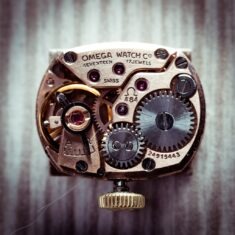
It would be a welcome new addition to the brand's offering instead of creating yet another version of watches we've seen for many years. Shifting their focus to developing new models would allow them to appeal both to the existing, history-fond clientele, but also discover a new one, exploring a space in the market and reaching new customers, something that Omega strongly needs.
As great as the Two Counter Pilot edition is, Omega Speedmaster will never be a pilot's watch, and that is perfectly fine - it is a Moonwatch, period. It is a Moonwatch, and it should remain just that —a top-of-the-class, mechanical watch with three counters, faithful to its interstellar (and racing) origins.
Omega has been my favourite watch brand, a sentiment shared by many other watch enthusiasts around the world. It was the brand that started the watch-collecting journey for many of us and one that personally has given me memories that I will treasure for the rest of my life.
Coming from the place of nothing but admiration and concern, it is time for us and Omega itself to admit that the brand has sailed off course.
The brand simply cannot be everything all at once- it needs to remember what made it so special in the first place, and that when you try to sell to everyone, you end up selling to no one.
By the same author:
A Pole in Space: Sławosz’s Odyssey
Sources:
The Swatch Group AG (UHR.SW) Stock Price, News, Quote & History - Yahoo Finance
Morgan-Stanley watchcharts 1st quarter 2025
Images:
xrrr Stock Image and Video Portfolio - iStock
Alexandros Michailidis Stock Image and Video Portfolio - iStock

A writer and analyst with a keen interest in the intersection of science, philosophy, and culture.