Artem Chebanenko: Turning Uncertainty into Action
Artem Chebanenko is a project and operations professional who turns incomplete information, competing priorities and hidden risks into... En lire plus

Geneva is undergoing a digital shift. Across finance, international organizations, and the tech sector, demand for data-literate talent is surging — yet Switzerland continues to face a shortfall of professionals capable of using complex analytical tools.
According to figures from the Organization for Economic Co-operation and Development (OECD), ICT and analytics job vacancies in Geneva are over 163% higher than the national average.
Despite heavy investment in AI and automation, many companies struggle to hire professionals capable of turning technical insights into decisions. Employers say the issue is no longer about finding pure programmers or traditional business graduates, but about employees who can operate between both worlds.
Albert School, which opened its Geneva campus in 2025, has positioned itself to address this challenge. Founded in Paris in 2022, the school integrates management, data science, and applied AI from the first year — a model that aligns well with the region’s shift toward cross-disciplinary talent.
The Geneva campus is led by Matteo Bianchi, whose academic background spans Bocconi University, HEC Paris, and the University of St. Gallen, as well as experience in investment banking, private equity, and data science.
His trajectory reflects the kind of profile local employers increasingly value and shapes a campus culture that is pragmatic, internationally oriented, and closely aligned with the dynamics of Geneva’s economy.
Albert School structures its programs around four pillars: Data & AI, Business, Mathematics, and Humanities.
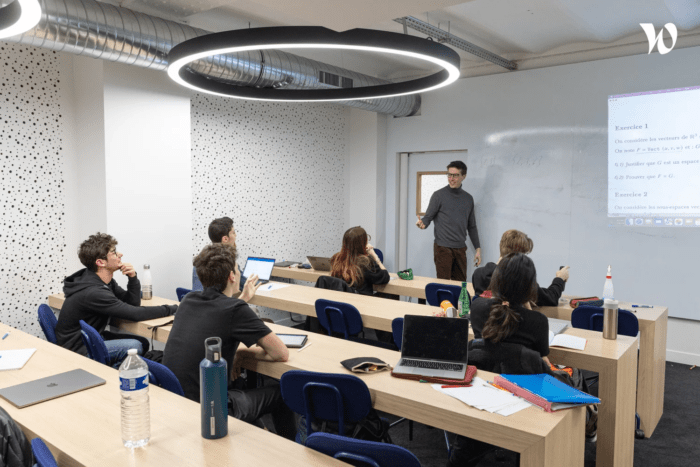
Bachelor’s students study Python, analytics, and machine learning alongside economics, geopolitics, and corporate finance. The aim is to train graduates who understand both how data informs decisions and how organizations integrate those insights.
The Master’s in Finance, Data & AI builds on the same philosophy, applying it to investment and quantitative analysis. Teaching staff include professionals with experience in companies such as Uber, Procter & Gamble, EY, and SILEX, giving students exposure to industry practices.
A central feature of the curriculum is the “Business Deep Dive,” a three-week consulting assignment based on real operational datasets.
In Geneva, the school’s partners include Edmond de Rothschild, Mantu, and SwissBorg. The campus has already completed two projects: one with a United Nations entity and another with Indosuez Wealth Management. In the latter, students analyzed more than 80,000 data points just weeks into the program — work that the partners described as surpassing expectations for that stage.
According to the school, around 30% of students secure internships through contacts formed during these projects.
Admission to the school remains competitive, with an acceptance rate of around 10%.
Cohorts of 30–40 students receive weekly academic coaching, a structure the school credits for its low drop-out rate. Tuition ranges from CHF 19,900 to CHF 26,900 per year, depending on program level and residency status; need-based financial aid is available.
Albert School’s first bachelor’s class graduated in 2025. While most have chosen to continue to the master’s program, others secure places at institutions, including INSEAD Business School, Carnegie Mellon, HEC Paris and Ecole Polytechnique. These early trajectories highlight the high calibre of students.
The school maintains a partnership with Mines Paris–PSL, ranked 28th globally in the QS World University Rankings 2026. Together, they offer joint bachelor’s and master’s programs in data science and management.
The school raised 11 million euros from 50 CEOs and entrepreneurs — Bernard Arnault from LVMH, Xavier Niel, Rodolphe Saadé from CMA CGM, and eight unicorn financiers. The investment backing shows how seriously people take the model of the school. “These are business leaders who recognize their own companies desperately need hybrid talent and are willing to invest long-term in creating it," Bianchi explains.
 Edmond de Rothschild, involved since the school’s inception, supported the establishment of the Geneva campus, now located within the group’s headquarters tower at Spaces Étang in the Quartier de l’Étang.
Courses are taught primarily in English, and students can rotate between campuses in Paris, Geneva, Marseille, Lyon, Milan, and Madrid.
Albert School operates on the premise that many of the jobs its graduates will hold a decade from now do not yet exist.
Roles such as AI strategist or prompt engineer, which were niche only five years ago, are now among the fastest-growing. Communication, analytical reasoning and teamwork carry as much weight as coding or statistics.
While AI accelerates computation, the ability to explain ideas clearly and question assumptions remains a fundamentally human skill — and a core element of the school’s teaching philosophy.
The decision to open a campus in Geneva was guided by local employer feedback and the region’s distinctive economic landscape.
International organizations such as the WHO, WTO, UNHCR, and ITU increasingly rely on data-driven analysis in policy, operations, and compliance — a concentration of roles unique within Switzerland. Geneva’s financial institutions and tech firms add a second layer of demand, particularly for profiles that can bridge analytics and strategic decision-making.
The local innovation ecosystem reinforces this dynamic. Trust Valley, the region’s cybersecurity and digital-trust initiative, along with long-standing incubators such as FONGIT, has helped cultivate a cluster of data-intensive startups. Nearby, Campus Biotech hosts major research groups and emerging AI-driven health-tech projects, further increasing demand for cross-disciplinary talent.
Within this environment, the skills Albert School provides — from analytical programming to quantitative reasoning and the ability to translate data into strategic decisions — closely align with the needs of Geneva’s key employers.
As a result, the school has expanded the pool of graduates trained to operate confidently across both technical and managerial domains. While its integration into the ecosystem is still at an early stage, institutions across Geneva point to a growing appetite for hybrid profiles — a trend that could shape the region’s economic trajectory in the years ahead.

With 13 years of experience in management accounting and active involvement in automation projects, I have firsthand insight into how technology is transforming work and the importance of adapting to stay relevant. Observing these changes in Geneva, I am curious about how businesses, educational institutions, and professionals are responding to this ongoing shift in the workforce.