Collectible and classic cars: A potential for investment?
Vintage cars are a financial asset that has the potential to give a good return on investment. There... En lire plus

The greatest value may be created not within individual technology verticals, but at their intersections.
In the late 1990s, many investors viewed the internet as a bubble. In many ways, they were right: the bubble did burst, the market capitalization of many companies disappeared, and thousands of business models proved unviable. But on the main point, the skeptics were wrong: the internet did not disappear. It became the infrastructure of a new economy.
The winners were not those who simply bought any internet company in 1999, but those who understood something deeper: a new technology first passes through a phase of overvaluation, then a phase of disillusionment, and only after that enters a long period of real-world adoption. It is during this period that the main value is created.
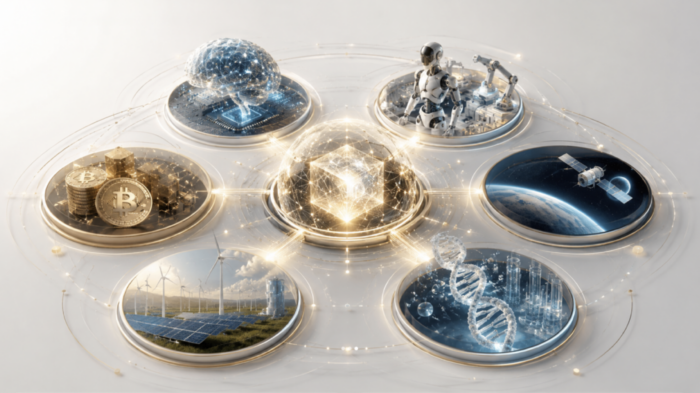
Today, the market may be at a similar point. But the difference in the new cycle is that we are not dealing with a single technology. These technologies are beginning to reinforce one another. Artificial intelligence controls robots and increases their autonomy. Robots, in turn, can build and maintain next-generation energy infrastructure. Biotechnology uses artificial intelligence to develop drugs, analyze data, and accelerate scientific discovery. Space systems provide global connectivity, navigation, and data transmission, becoming a foundation for distributed digital networks. Everything reinforces everything else.
As a result of this convergence, new markets are emerging whose potential value may be measured in trillions of dollars. These technologies are already functioning and are gradually becoming the infrastructure of a new economy. However, a significant part of their future use cases is still only taking shape.
My main investment thesis is as follows: over the next 20 years, the greatest value may be created not within individual technology verticals, but at their intersections.
It is precisely at the intersection of artificial intelligence, robotics, energy, biotechnology, space, and digital assets that one of the main drivers of new wealth creation in the 21st century may emerge.
The key questions are which platforms will become the new infrastructure of the economy, who will control the bottlenecks of that infrastructure, and how an investor should allocate risk across several megatrends simultaneously.
Artificial intelligence is becoming the infrastructure of the new economy - a horizontal technology embedded into software, manufacturing, finance, medicine, education, logistics, defense, and energy.
In its logic, AI resembles electricity or the internet: its importance lies not only in standalone applications, but in its ability to increase the productivity of other industries. Research and consulting reports increasingly describe generative AI as a general-purpose technology.
From an investment perspective, this means that the AI value chain is broader than it may appear. At the first level are producers of computing infrastructure: NVIDIA, AMD, TSMC, ASML, and Broadcom. At the second level are cloud platforms and hyperscalers: Microsoft, Amazon, Alphabet, and Oracle. At the third level are companies that turn AI into applied solutions: Palantir, ServiceNow, Snowflake, Datadog, and others. At the fourth level are private companies such as OpenAI, Anthropic, xAI, Mistral, and Databricks.
But this is where the first risk appears. The more obvious a trend becomes, the higher the probability of overvaluation. An investor may be right about the technology but wrong about the asset's price. Therefore, in AI, it is important to look not only at revenue growth, but also at margins, the durability of demand, the cost of compute, and companies' ability to turn AI enthusiasm into real free cash flow.
My view: AI is the central platform of the new cycle, but it is not the only one. The most interesting investment opportunities may arise not only in AI companies, but also in sectors that AI makes more productive. The technology is already working, but a significant part of its future use cases has not yet been realized.
If artificial intelligence is the brain of the new economy, robotics may become its hands.
While investors' attention is focused on language models, the next stage of automation is forming in parallel: physical AI. This includes robots, drones, autonomous transport systems, warehouse automation, medical robots, industrial manipulators, and, possibly, humanoid robots.
Robotics has several structural drivers. The first is demographics. Europe, Japan, South Korea, and China are facing population ageing and labour shortages. The second is rising labour costs. The third is reshoring and nearshoring, as companies seek to bring production closer to the end consumer. The fourth is the development of AI, computer vision, sensors, and batteries.
The International Federation of Robotics says that in 2024, 4,663,773 industrial robots were operating worldwide, with 542,076 new installations.
Key companies in this area include ABB, Fanuc, Yaskawa, Keyence, Siemens, Rockwell Automation, Intuitive Surgical, Teradyne, Symbotic, Amazon Robotics, Tesla Optimus, Figure AI, and Boston Dynamics.
Switzerland is especially interesting. ABB is one of the global players in industrial automation and robotics. At the moment, the ABB Robotics division is in the process of being sold to SoftBank. Switzerland can be seen not only as a financial centre, but also as a participant in the physical automation of the new economy.
My view: robotics is still less fashionable than AI, and precisely for that reason it may be more interesting for a long-term investor. The question is not whether robots will replace all humans. The question is which industries will be the first to find economic justification for automating physical labour.
Space is no longer exclusively a government program. Over the past twenty years, it has become a commercial market: launch services, satellite internet, remote Earth observation, defence technologies, navigation, communications, and, further in the future, manufacturing, computing, and energy infrastructure in orbit.
According to the Space Foundation, the global space economy reached USD 613 billion in 2024; the commercial sector accounted for 78% of the total, and the organization estimates that the USD 1 trillion mark may be crossed as early as 2032.
Against this backdrop, SpaceX has ceased to be merely a private Silicon Valley legend and has become a public market test for the entire theme. The United States Securities and Exchange Commission records that the company filed Form S-1 on May 20, 2026. According to Reuters, the offering took place on June 12 for USD 135 per share, initially raised USD 75 billion, and after the underwriters exercised their option, the IPO size increased to USD 85.7 billion. Reuters also described the offering as the largest IPO in history.
For a long-term investor, however, the IPO itself is less important than the fact that SpaceX combines several areas of technological convergence: reusable rockets, Starlink satellite communications, Starship, defence infrastructure, potential data-transmission channels, and, in the future, possibly orbital computing. This is why the market values the company not only as a rocket manufacturer, but as a platform at the intersection of space, communications, artificial intelligence, defence, and energy.
At the same time, the risks remain significant. SpaceX depends on capital-intensive projects, regulatory decisions, the successful development of Starship, competition, government contracts, and its ability to justify a very high valuation. Even if space truly becomes one of the key layers of the 21st-century economy, that does not mean that entering at any price will be justified from an investment perspective.
My view: space technologies matter not by themselves, but as part of a new infrastructure - alongside AI, energy, robotics, defence, and digital networks. In this context, SpaceX is an example of how capital is beginning to reprice the strategic importance of space infrastructure.
The stronger the narrative, the greater the need for disciplined analysis of valuation, risk, and expectations.
Public companies in the sector: SpaceX (SPCX), Rocket Lab (RKLB), AST SpaceMobile (ASTS), Intuitive Machines (LUNR).
Indirect exposure: Amazon (AMZN), Nvidia (NVDA), Palantir (PLTR).
Biotechnology is one of the most complex sectors for an investor. Here, enormous potential is combined with high uncertainty: clinical trials may fail, regulatory processes can take years, and a single successful molecule does not always become a sustainable business model.
AI can change this industry, but not magically. It can accelerate molecule discovery, protein-structure analysis, therapy design, clinical-trial data processing, and treatment personalization. However, AI does not cancel biological reality: a drug must still pass laboratory research and clinical trials, prove its safety and efficacy, receive regulatory approval, and find a market.
Companies worth monitoring include CRISPR Therapeutics, Moderna, Illumina, Regeneron, Vertex, Recursion Pharmaceuticals, Schrödinger, 10x Genomics, Tempus AI, Roche, and Novartis.
Switzerland holds a notable position in this field thanks to CRISPR Therapeutics (CRSP).
Basel is one of the world's strongest pharmaceutical clusters; Roche and Novartis remain global giants, while ETH Zurich and EPFL provide a strong scientific foundation.
My view: biotech is not the easiest sector for a private investor, but it cannot be excluded from the map of technological convergence. If AI truly accelerates scientific discovery, biotechnology may become one of the main beneficiaries of the next cycle.
One of the most important ideas for an investor is simple: the digital economy does not exist without physical infrastructure.
Every data centre, every AI model, every robotic factory, every chip fabrication plant, and every satellite network requires energy. Therefore, the technological revolution depends not only on algorithms, but also on power grids, generation, transformers, energy storage, and load management.
The IEA expects a significant increase in electricity consumption by data centres by 2030. The issue is not only the global volume of demand, but also its local concentration. Data centres are built in specific regions where the grid may not keep pace with rising load.
This changes the investment map. Alongside AI companies, investors should look at energy: NextEra Energy, Brookfield Renewable, Constellation Energy, Cameco, GE Vernova, Siemens Energy, Schneider Electric, Eaton, Tesla Energy, Fluence, First Solar, CATL, and BYD.
The most interesting areas include power-grid modernization, energy storage, nuclear energy, small modular reactors, transformers, energy-consumption management, and software for load optimization.
My view: energy is not a boring sector sitting next to technology. It is a bottleneck of the technological revolution. If AI continues to grow, energy may become one of the most important investment layers of the new cycle.
The five areas discussed in this first article are not separate stories. Artificial intelligence needs computing power, data centres, energy and advanced chips. Robotics turns software intelligence into physical productivity. Space systems expand connectivity, observation and strategic infrastructure. Biotechnology uses AI to accelerate scientific discovery. Energy makes all of these layers possible.
For investors, the first step is to understand these platforms as the infrastructure of the next economy. The second step is to ask how this infrastructure can become an investable theme: where ownership is represented, how assets are settled, how regulation creates trust, how capital should be allocated and how risk should be managed.
That is the focus of the second part of this series: blockchain and digital assets, Switzerland as a technology and finance hub, capital allocation, risks, and the broader conclusion that the future may be formed at the intersections.
This material is for informational and educational purposes only and does not constitute individualized investment advice. All investments involve the risk of capital loss.
Further reading: Dropshipping Is Not Light. It Simply Hides the Weight of Risk
Image: ChatGPT

Specializing in finance, digital assets, investment research, and financial education