Make LinkedIn Work for You: Profile, Content and Analytics
LinkedIn is more than an online CV; it is a tool for building professional visibility, communicating your expertise... En lire plus

What if AI-generated content becomes so common that people start craving something more human?
Or what if consumers simply stop caring whether a piece of content was created by a person or by a machine?
Both futures are plausible.
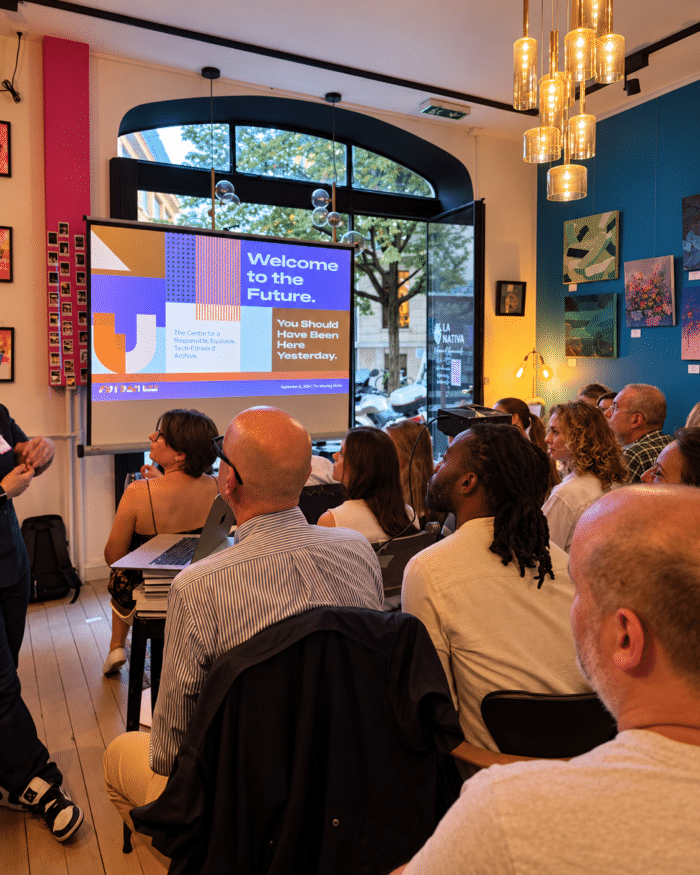
That was one of the ideas at the heart of the latest The Marketing Meetup Geneva, where MC Casal led a session on strategic foresight and how marketers can prepare for change without pretending they know exactly what is coming next.
More than just another networking event
The Marketing Meetup is part of an international community of around 51,000 marketing professionals, connected through events, webinars, podcasts and learning initiatives.
When I spoke with Sandra, from the Geneva organising team, one thing became clear: although the city is home to multinational companies, NGOs and international institutions such as the United Nations, there were relatively few local opportunities for marketing professionals working in English, across cultures and markets, to connect. The Marketing Meetup Geneva was created to help fill that gap.
The aim is not simply to exchange business cards or look for the next client, but to create a space where professionals can learn from one another, discuss changes in the industry and build genuine relationships.
Sandra described the community as “genuine, supportive and welcoming”, a spirit that also reflects The Marketing Meetup’s wider motto: “Be positively lovely.”
Even the networking has its own rule. Attendees are encouraged to keep conversation circles open so that someone new can easily join — something the organisers jokingly call “Pac-Man-style networking.”
It is a small detail, but one that captures the atmosphere of the event: open conversations, different perspectives and less pressure to sell.
That made strategic foresight a particularly fitting topic for the evening.
Marketing teams are used to quarterly targets, annual budgets and campaign calendars. Major change, however, rarely follows those timelines. The pandemic, the introduction of the General Data Protection Regulation (GDPR), the rise of smartphones and, more recently, artificial intelligence have all transformed how brands communicate with customers — often faster than organisations expected.
During the session, MC Casal explored a simple but important distinction; traditional forecasting tends to focus on what is most likely to happen. Strategic foresight asks something broader: what could happen?
Rather than building a strategy around one expected future, teams explore several plausible scenarios and test how well their current decisions would hold up under each of them.
The goal is not to predict the future more accurately; it is to make better decisions in the present.
AI was one of the clearest examples discussed during the session.
Imagine a future where AI agents handle most customer enquiries, advertising is personalised instantly and content production becomes largely automated.
Now imagine another where consumers become tired of polished AI-generated content and start valuing communication that feels more spontaneous, imperfect and human. Neither scenario is guaranteed.
A company that prepares for only one of them risks making its strategy dependent on an assumption that may never become reality. Strategic foresight gives marketers a way to explore both possibilities before they must react to them.
What I found particularly interesting was how practical the concept became once it was connected to real marketing decisions. Strategic foresight can sound abstract at first, but the examples around AI, customer behaviour and regulation made it immediately relevant.
Another idea that stood out was the importance of weak signals.
These are small changes that may seem insignificant today but could become important over time: a new customer behaviour, an emerging technology, a cultural shift or a regulatory debate.
On their own, they may mean very little. But when several signals begin pointing in the same direction, they can reveal that something larger is starting to change.
A practical marketing example could be the gradual shift away from third-party data. At first, stricter privacy rules, browser restrictions on cookies and consumers becoming more cautious about sharing personal information may appear to be separate developments. Together, however, they signal a broader change in how marketers can collect and use customer data. A brand that notices these signals early can start investing in first-party data, stronger customer relationships and more transparent communication before the change becomes urgent.
For marketers, noticing those signals early creates something valuable: time to experiment, adapt and rethink decisions before change becomes urgent.
 Scenarios instead of predictions
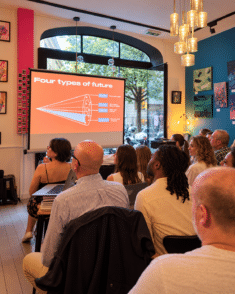
One practical approach presented during the session was to work with several scenarios.
The purpose is not to choose which scenario will come true. It is to understand how resilient the current strategy would be under different conditions. A strategy that can adapt across several futures is likely to be more robust than one built around a single prediction.
What I took away from the session was not a better prediction of what marketing will look like in 2030 or 2035. It was a different way of thinking about uncertainty.
Strategic foresight encourages teams to challenge assumptions, pay attention to emerging signals and make decisions that can remain valuable across several possible futures. For an international and diverse community such as The Marketing Meetup Geneva, that message feels particularly relevant. Its members work across industries, cultures and markets where technological, regulatory and behavioural change is constant.
The future will remain unpredictable.
The real advantage is not knowing exactly what comes next, but being ready to adapt when it does.
Images: Patricia Avila
Further reading: How AI Is Reshaping SEO: What Businesses Need to Know Now
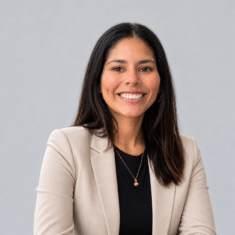
My background in administration, logistics, and marketing has given me a versatile skill set and a practical understanding of how businesses work. Today, I bring this experience into marketing and communication.