Make LinkedIn Work for You: Profile, Content and Analytics
LinkedIn is more than an online CV; it is a tool for building professional visibility, communicating your expertise... En lire plus

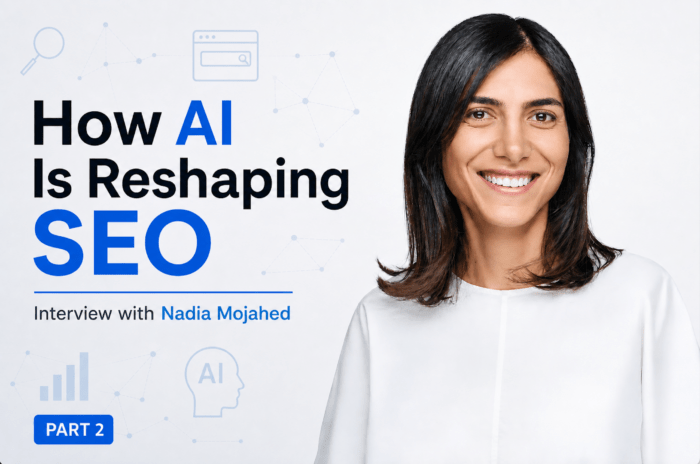
The pace of change in the digital space has never been greater. AI is doing more than impacting SEO, it is transforming the mechanics of search, redefining how content is discovered and shifting decision-making from humans to increasingly automated systems.
To better understand what these changes mean in practice, I spoke with Nadia Mojahed, a Geneva-based SEO and AI strategy consultant and founder of SEO Transformer. Also, a lecturer in Digital Marketing at the Swiss School of Business and Management and speaker, Nadia helps organisations turn search into a scalable growth engine by combining technical SEO, data insight and content strategy.
In article 1 of this series Nadia explained how AI is transforming search, and here she shares her thoughts on what businesses should focus on today, and how to stay competitive in this rapidly shifting environment.
Nina: What about new brands? I hear a lot: “If AI prefers strong brands, what chance do new brands even have?” Can they compete in AI-driven search?
Nadia: It depends on one key thing: does this new brand have something new to say, or is it just copying AI-generated and SEO-optimized content and publishing it?
If the content is copied, doesn’t bring value, and doesn’t include original or proprietary information or data, then it will be very difficult to rank or be visible.
But if a new brand brings something fresh, valuable data, insights, real expertise, then yes, it can grow. Of course, it also needs the right website technology to support it. It will take time, but the growth will be consistent.
And with all these shifts and changes, there are actually a lot of opportunities for new brands. If bigger brands don’t adapt quickly, it creates space for those who are doing it right.
Nina: Even in competitive markets like fashion? How they can compete with the worldwide famous companies?
Nadia: It depends on differentiation. If you’re in a specific niche, your chances increase.
But if you're talking about winter jackets, for example, you may need:
The more niche you go, especially in highly competitive markets, the better your chances.
This niche doesn’t have to be only about the product itself or its functionality. It can also be about the community or the “club” aspect around the brand.
There are different ways to build that unique added value, which ultimately supports visibility and return on investment.
Nina: What’s specific about the Swiss market?
Nadia: The Swiss market is very special. As you mentioned, it’s expensive, but there is strong purchasing power.
At the same time, localization is key. It’s not just translation. It’s adapting the website and brand communication to different languages and audiences, which requires more time and effort.
Compared to larger markets like the USA, where one language dominates, tools and updates roll out faster. In Switzerland, they often come later, partly due to regulations like GDPR.
This can also be an advantage you can observe how things perform in other markets and be better prepared.
Switzerland is a smaller market, so localization for different audiences is essential. If done well, it brings strong results, especially when you understand what works locally.
It still depends on the industry whether it’s a lawyer, SaaS, prop-tech, or interior design.
There are common foundations, like localization and local SEO, but results vary depending on:
So, while the basics are shared, execution depends on many factors.
Nina: What about backlinks for small local projects?
Nadia: The question is not whether you need backlinks or not. The real question is: where is your website in its SEO journey, and are the basics already covered? Because it’s not just about the backlink itself, but about:
A truly earned backlink brings more than just an SEO signal. It can bring visibility, traffic, and access to a relevant audience. But backlinks are not always the priority. The key is to understand what the website actually needs to drive results.
In many cases, basic elements are still missing. Sometimes it’s accessibility, sometimes technical setup, sometimes small but critical issues. Fixing these can already improve rankings, without going into additional tactics.
That’s why it should always start with a proper review:
Then you define the strategy and implement it step by step. Without this foundation, efforts often become scattered, and results are limited.
Nina:If you look ahead 2-3 years, what will actually change in practice perspective?
Nadia: From a practice perspective, I would split it into three parts.
There will be significant shifts. For example, Google is testing dynamically AI-generated landing pages. If implemented, this could change how tools diverge, emerge, or converge. Search may evolve in ways we are not used to.
The foundations will remain, but how they are applied will change. The elements are the same, but how you combine and use them will evolve.
The foundations are still there, but what you add, how you use tools, and how you approach execution will continue to evolve. Technical optimization will become more important, especially with the growth of agentic AI. Without strong technical integrity, it will be difficult to perform.
At the same time, platforms are adapting, website technologies are integrating more AI capabilities, and tools are evolving to keep up.
Overall, there are many changes: new players may appear, existing ones will adapt, and tools and platforms are redefining the landscape.
Nina: What challenges do you face in real projects?
Nadia: For each project, there are always challenges, and as the project evolves, new ones appear.
These can come from different areas:
It depends on the organisation, the website, and the team behind it.
At the same time, it’s also the role of the expert to explain the value: why this is needed, how it connects to business priorities, and what results to expect.
It’s about making implementation easier: breaking it into steps, aligning with stakeholders, and following up to make it happen.
AI is not replacing SEO; it is redefining its scope.
The fundamentals remain, but the level of complexity is increasing. Success today requires not just execution, but strategic understanding: how search works, how AI systems interpret content, and how to align both with real business goals.
For companies, the takeaway is straightforward: those who adapt early, and build the right foundations, will gain a measurable advantage in visibility, traffic, and conversions.
🧾 Part One - How AI Is Reshaping SEO: What Businesses Need to Know Now
🧾 Pourquoi les campagnes Google Ads échouent en Suisse et comment les faire fonctionner
🧾 Why Google Ads Campaigns Fail in Switzerland - And What to Do About It
🧾 Réflexions sur l'atelier Google Ads : stratégie, structure, localisation
🧾 Google Ads Workshop Reflections: Strategy, Structure, Localization

I analyse projects, including contextual advertising audits. I identify weaknesses and highlight opportunities you may not even be aware off.