
SECO – Situation du marché du travail en septembre 2026
En septembre 2026, le nombre de chômeurs recule légèrement à 140’480 (-0,8% sur un mois) mais demeure supérieur... En lire plus

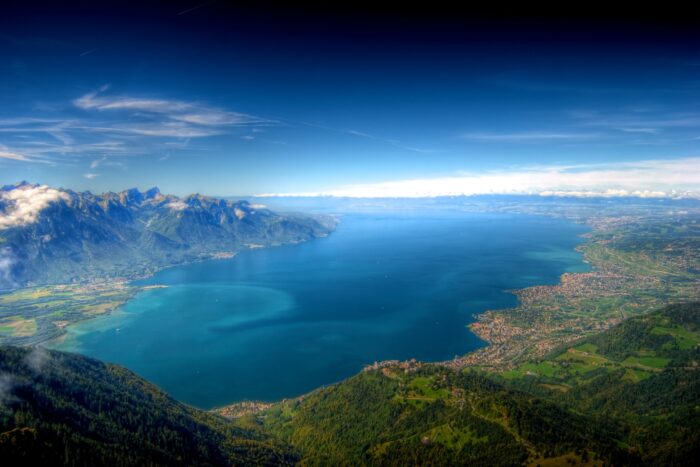
For anyone living or working in Geneva, Lac Léman is a familiar and majestic part of the daily landscape. We hold business meetings along its promenades, admire its sunsets, and see it as a symbol of Swiss tranquillity. Yet beneath this idyllic surface lie astonishing scientific phenomena, historical curiosities, and grand mysteries.
As your guide to Savoir-Vivre, I invite you to look below the surface and decipher the lake’s true “water code”. Personally, I love to be amazed—and, truth be told, I love to amaze others. That is why I have gathered 10 facts that will make you see our familiar lake through a completely different lens.
The landscape we admire daily from Geneva’s office windows and promenades is a monumental “scar” of the Ice Age. Around 15,000 years ago, the area now occupied by Geneva was completely buried beneath the colossal Rhône Glacier. Directly above the spot where the Jet d’Eau shoots up today, the ice was an incredible 700 metres thick. As this icy giant melted and retreated, it left behind a deep tectonic basin that filled with meltwater, forming the majestic Lac Léman.
Switzerland is synonymous with safety, and Lac Léman with idyllic tranquillity. This makes the fact that the lake can experience devastating tsunamis all the more astonishing.
In AD 563, a colossal landslide at the far end of the lake unleashed a giant wave. For centuries, historical accounts were dismissed as exaggerations, until 21st-century geologists from the universities of Geneva and Lausanne scanned the lake bed. They discovered a massive layer of ancient sediment, confirming that a wall of water up to 13 metres high had swept across the basin, devastating Geneva and destroying bridges and city walls. Hard as it is to imagine today, this tsunami was a historical reality, not a myth.
Geneva is firmly associated with cutting-edge science thanks to CERN, but this tradition began long before nuclear research. In 1827, physicist Jean-Daniel Colladon and mathematician Charles-François Sturm chose Lac Léman to make the first accurate measurement of the speed of sound in water.
Gunpowder ignited on one boat provided a flash of light, while an underwater bell produced a sound detected from another boat 13 kilometres away. This landmark experiment demonstrated that sound travels more than four times faster in water than in air, laying the foundation for modern hydroacoustics.
We all know from our school days that Switzerland is landlocked and that more than 60% of the country is covered by mountains. But have you ever wondered how, without a coastline, the Swiss measure the altitude of their Alpine peaks “above sea level”?
The answer lies right in Geneva’s harbour. Here, two granite boulders left behind by a retreating glacier emerge from the water: the Pierres du Niton. In the 19th century, the great Swiss general and topographer Guillaume-Henri Dufour used the larger boulder as his reference point. By linking its elevation to sea level in France, measured at Marseille, he made this rock the primary reference point for the country’s first official map.
To this day, every altitude across Switzerland—from the summit of the Matterhorn to the elevation of railway tracks—is calculated relative to this humble stone in Lac Léman. Whenever I share this secret on my guided tours, my guests tell me they see these grey stones in a completely different way: as a true monument to Swiss precision.
Scientists from the École polytechnique fédérale de Lausanne (EPFL) discovered an astonishing phenomenon: a giant internal wave lives in the depths of Lac Léman. While the surface may be perfectly calm, with yachts sitting motionless, colossal masses of water are shifting below.
Generated by differences in temperature and water density, this hidden wave travels along the entire coastline. It drives deep-water currents, transports sediment from the Rhône, and distributes nutrients, acting as the invisible “director” of the lake’s ecosystem.
Lac Léman is one of the most thoroughly surveyed deep freshwater bodies in the world, having been explored by four submarines.
The first was the Auguste Piccard Mésoscaphe in 1964—the world’s first passenger submarine and the largest non-military submersible of its time. Designed by the great Swiss oceanographer Jacques Piccard for the Swiss National Exhibition of 1964 in Lausanne, it remained active until 1965. It completed around 1,100 dives to depths of roughly 150 metres and carried more than 33,000 passengers, opening up Léman’s underwater world to the public. Today, the fully restored original is on permanent display at the Swiss Museum of Transport in Lucerne.
Jacques Piccard built the second submarine at his own shipyard in Geneva, naming it the F.-A. Forel in honour of François-Alphonse Forel, the founder of limnology—the science of lakes. This research vessel operated in Lac Léman for nearly three decades until its retirement in 2005. Scientists from the universities of Geneva and Lausanne used it to study the lake’s ecology, currents, and lake-bed sediment.
In 2011, the most extensive scientific lake expedition of modern times took place. As part of the international Elemo expedition, the legendary deep-sea submersibles Mir-1 and Mir-2 descended to the floor of Léman. These two orange-and-white, 18-tonne submarines, famous for filming the wreck of the Titanic for James Cameron’s iconic film, explored the lake’s deepest and most hazardous areas. These included the Rhône’s underwater canyons at depths exceeding 300 metres.
Scientists collected core samples to analyse the spread of micropollutants and better understand underwater landslides—one of which had triggered the devastating tsunami of AD 563.
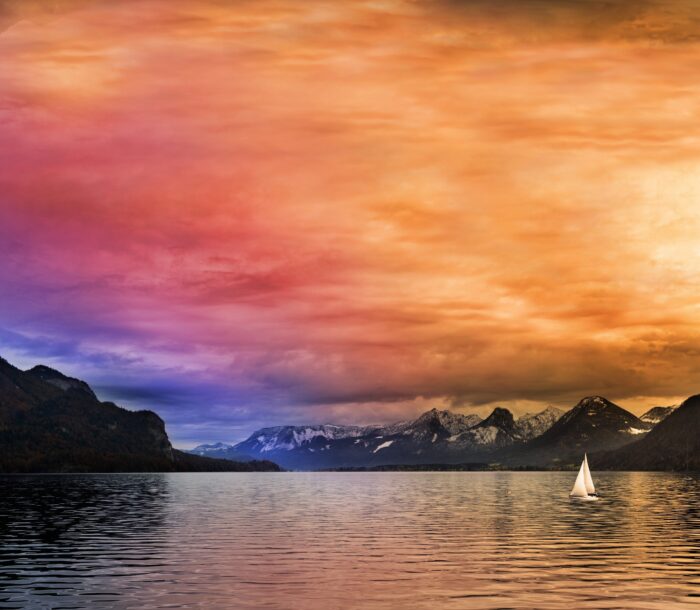 Although Lac Léman is isolated from the world’s oceans, its waters have a rhythm of their own. Changes in atmospheric pressure and wind can set the lake’s water oscillating back and forth, rather like water sloshing in a giant bathtub. These movements, known as seiches, cause the water level along the shores to rise and fall. Unlike ocean tides, they are not driven by the gravitational pull of the Moon and Sun.
On my guided tours, visitors often tell me that Lac Léman feels like a real sea, just without the salt. With its seemingly endless horizon, calling seagulls, and ever-changing waters, it is easy to feel as though you are relaxing at a luxury seaside resort.
Lac Léman has not always appeared under the same name on maps. During the Middle Ages and the Renaissance, its widest and deepest section—the Grand-Lac—was sometimes labelled “Lake Lausanne” (Lacus Lausannensis), reflecting Lausanne’s influence at the time.
Geneva would also lend its name to the lake, giving rise to “Lake Geneva”, the name familiar to many English speakers today. These different names tell a story of competing local influences, but Lac Léman remains its traditional French name.
While many people abroad associate the lake with Geneva, locals know that Lac Léman holds true “dual citizenship”. About 60% of its surface belongs to Switzerland and 40% to France, with the international border running through the water. Every day, thousands of French cross-border commuters (frontaliers) cross this invisible line on CGN ferries to reach their offices in Geneva.
This introduces another fascinating Swiss paradox: although Léman is the largest lake in Western Europe, its shared status means it is not the largest lake lying entirely within Switzerland. That title goes to Lake Neuchâtel.
Of course, what would a story about Lac Léman be without its famous fountain? Shooting 140 metres into the sky, the Jet d’Eau is celebrated today as a triumph of aesthetics and tourism. Yet few realise that it was never intended to be a landmark.
In 1886, it served as a safety valve, releasing excess pressure from the city’s first hydroelectric facility on the Rhône. When engineers noticed the awe this powerful plume of water inspired, the system was upgraded, illuminated, and relocated to the centre of the harbour.
Thus, a technical necessity became one of Switzerland’s signature sights and one of the tallest fountains in the world. It has even been photographed from space: in 2021, astronaut Thomas Pesquet shared a photograph taken from the International Space Station in which the Jet d’Eau could be spotted.
The author, Iia Lyskova, is an expert guide to Geneva and Switzerland, and your personal companion in the world of Savoir-Vivre. She specialises in signature guided tours, tailor-made private and group itineraries, and VIP concierge services across Geneva and Switzerland.

I conceive ‘cultural immersion’ tours which enable anyone, delegation member, expatriate family or even curious visitor, to feel at home in the local culture.