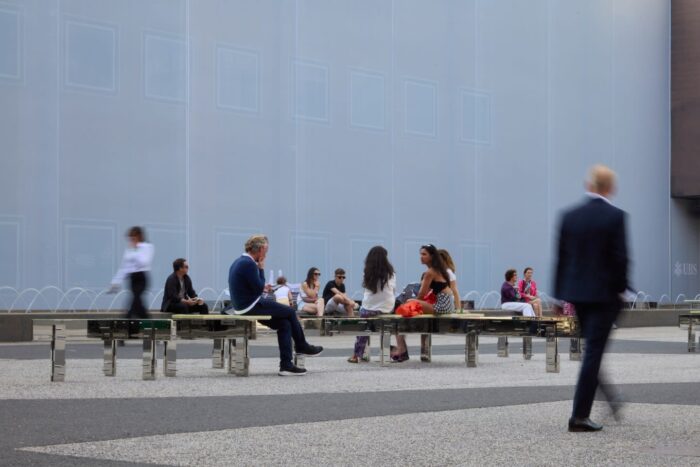
What Makes Us Stop? A Designer’s View from Art Basel 2026
At Art Basel, attention felt like the real currency, with visitors drawn to works that offered a clear... En lire plus


It is reported that no fewer than 300 Picassos were stored in Geneva’s free ports in 2014, along with countless Degas, Monets and Rothkos¹ belonging to art dealers and collectors. Paintings are being kept in these confidential and safe deposit boxes next to gold bars, jewelry, rare wines, antiquities and other riches free from VAT and customs duties. The Canton of Geneva, who at 86% is the majority owner of the “port francs de Genève”, has no clue of how much art is stockpiled in this fiscal no-man’s land.²
There is nothing surprising about the fact that fine art is treated like any other tangible assets by investors seeking to diversify their investments, especially after the financial crisis. What is attracting even more attention is the speculative bubble growing around it, which often leads to overpricing. The recent arrest of the Swiss Art transporter, Yves Bouvier, in Monaco is a telling example. Bouvier was accused of major fraud such as inflation and money laundering by Russian businessman Dmitri Rybolovlev, to whom he sold 38 masterpieces between 2003 and 2014 for a total value of €2 billion. This case is one among many that highlight the lack of transparency in art pricing and the climate of suspicion.
Undeniably, the industry of fine art has money: $15.2 billion were spent in auctions in 2014 alone, which is equivalent to the GDP of the country of Senegal. If private sales are included, the total is closer to $51 billion.³ According to Artprice.com, the historic record of sales in auctions represented a 26% increase compared to 2013.4 Speculation is mainly the reason why 1,679 art pieces were sold for over a million dollars each last year, with the value of some paintings doubling or tripling in less than five years. Such was the case for the famous “Blue Star” by Joan Miro, which was acquired by Sotheby’s for $13 million in 2007 and sold for £23 million (around $36 million) in 2012.
Growing anxiety, however, is undoubtedly a side effect of this phenomenon of overinflation. The Art Newspaper, an online and paper publication specialized in visual arts, even asked the question “How long can the art market walk on water?” three years ago, showing concerns about the “overconfidence” dominating the art market even in turbulent times. The article, however, does mention an important point: the phenomenon is particularly observed among top artistic works, only traded by the ultra rich.
In other words, the trend is far from general, and the spectacular prices can only be attributed to a handful of selected artists who attract the attention of a few high-net-worth individuals. This proves that ultimately, most buyers are still attracted to signatures rather than art itself.5 For example, those who sold for the most in 2014 were Andy Warhol representing $569 million in sales, followed by Picasso, Francis Bacon, Gerhard Richter, Mark Rothko, Claude Monet and Qi Baishi.
In order to know which institutions and individuals are ready to pay these astronomical prices for modern art, one just has to look towards newer economies. Having experienced volatile financial markets and often lacking maturity, these economies saw the rise of super rich individuals who chose to hold up to 20% of their assets in luxury goods rather than traditional investments. Naturally, China and the Gulf States (Saudi Arabia, UAE and Qatar) come to mind, where new museums open every month and thus world-famous art is always in demand. American, Russian, Indian and European fortunes continue to act as strong pillars for the industry, but new actors are also constantly entering the art scene. Such is also the case with major banks, such as Deutsche bank sponsoring London’s Frieze Art Fair and acquiring its own large art collection, or UBS being the lead partner of Art Basel.
One last question remains: how are prices actually decided? During the past few years, some recurrent patterns appeared, a testament to the presence of risk aversion and vigilance from buyers and sellers, which in turn impacted the pricing strategy. Buyers adhere more and more often to the traditional tenets of the trade. Therefore, when considering a work of art, they especially look at its provenance, rarity (existence of serial context) and scarcity, condition, supply and demand.6 Furthermore, "historical footprint" has become a gauge of value, along with named and established sellers and current trends. When all of these factors are combined, they give a sort of prestigious pedigree to the work.
However, the art pricing mechanism is complex and there are many theories detailing the long validation process through which artwork progresses from the studio to the market. One such theory, called Drummond’s model (2006), establishes five steps (creation, quotation, interpretation, re-contextualisation and consumption) that lead to market. Yet the theory suggests that there is little chance for an artist to get to the point of making money in his or her lifetime.7 It is therefore difficult to apply such a model to contemporary art, since artists like Andy Warhol (1928-1987) proved the opposite. Indeed, Warhol reached the phase of mass consumption while in the first phase of Drummond’s model, thanks to a combination of factors involving marketing and entrepreneurial branding, but also interacting forces such as curators, dealers, galleries, critics and theoreticians, auction houses, commercial art fairs and arts events, collectors, investors and museums. In addition, art remains in strong correlation with regional prosperity and it could, just like it did in the 1990s due to the Japanese crisis in property prices, suffer from recession if the current slowdown in China continues.8
Despite the fact that fine art is seen as the “new gold” by some professionals, still 80% of buyers are actual art aficionados, while 20% are investors.9 The art world remains a closed one, with a large part of transactions being settled in cash during private sales. That also makes it a well-suited environment for money laundering and general speculation. Such artificial prices may collapse at some point, as has happened with many commodities, but can we predict the real consequences? Also, in this article, art is considered in the limited scope of business transactions, although we know that the broader purpose of art is cultural, social and even existential.
Sources:
1 http://www.spiegel.de/international/business/art-as-alternative-investment-creates-storage-business-tax-haven-a-912798.html
2 for more information about how free ports operate in Geneva, check out the New York Times article : http://www.nytimes.com/2012/07/22/business/swiss-freeports-are-home-for-a-growing-treasury-of-art.html?_r=1
3 http://www.tefaf.com/DesktopDefault.aspx?tabid=15&tabindex=14&pressrelease=16959&presslanguage
4 http://www.huffingtonpost.fr/jerome-stern/economie-marche-art_b_6800178.html
5 http://www.business-standard.com/article/beyond-business/art-pricing-for-dummies-114080101666_1.html
6 http://old.theartnewspaper.com/articles/How-long-can-the-art-market-walk-on-water/26752
7 http://www.academia.edu/3514994/The_art_machine_Dynamics_of_a_value_generating_mechanism_for_contemporary_art
8 http://old.theartnewspaper.com/articles/How-long-can-the-art-market-walk-on-water/26752
9 http://tempsreel.nouvelobs.com/culture/20120613.AFP9318/l-art-devient-une-valeur-refuge-en-temps-de-crise.html
Photo credit: beludise via Pixabay, CC0 Public Domain License
I find it strange that art is being stored in warehouses instead of being displayed. I believe that artists create art to be seen.