5 Sites to Spark Design Inspiration
This article explores five websites that can help creatives find fresh inspiration: Awwwards, WePresent, Behance, Dribbble and Figma... En lire plus

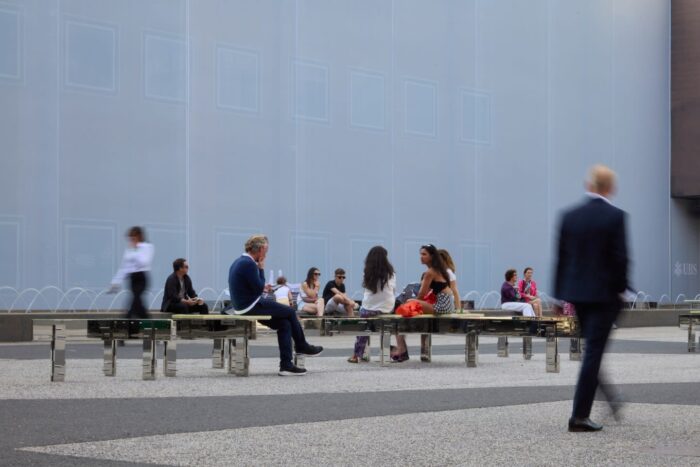
Site-specific commission across Messeplatz by Nairy Baghramian. Courtesy of Art Basel.
At an event with 290 galleries, it is impossible to see everything.
This year’s Art Basel 2026 welcomed 90,000 visitors. For me, that made attention feel like the real currency of the day.
As a visual designer, I did not go to assess every piece. I wanted to observe what made people slow down, look more closely, take a photo or simply walk on.
Across the fair, three things stood out: material and narrative create a first point of entry; the way a space is organised affects how long people engage; and participation can turn viewing into a memorable experience.
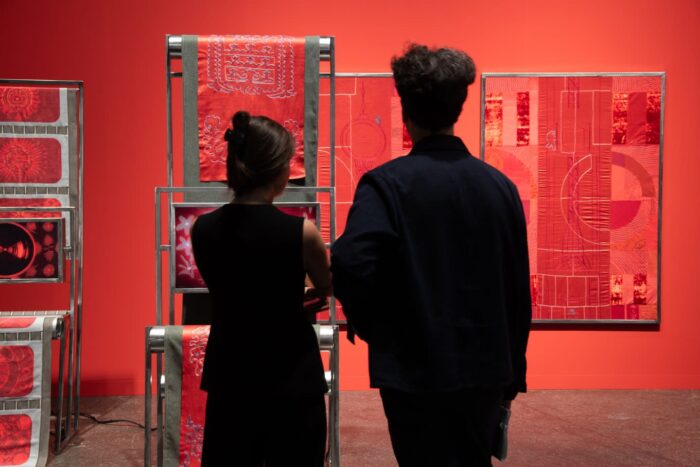
Aziza Kadyri. Courtesy of Art Basel
In the first, open space, visitors seemed to spend more time with work that offered an immediate invitation.
Moffat Takadiwa’s The Water Vessels, made from discarded keyboard keys, pen casings and plastic-bucket handles, was one example. The contrast between black keys and fluorescent plastic made people stop before they understood the full concept. Once they recognised the materials, many looked closer.
Other large or abstract works could be just as powerful, but often needed more context. The extended descriptions in this section were valuable. They turned a quick visual impression into an entry point: what is it made from, where did it come from, and why has the artist chosen it?
This applies beyond a gallery. A campaign, product page or exhibition does not have to explain everything immediately. But it should offer a reason to enter.
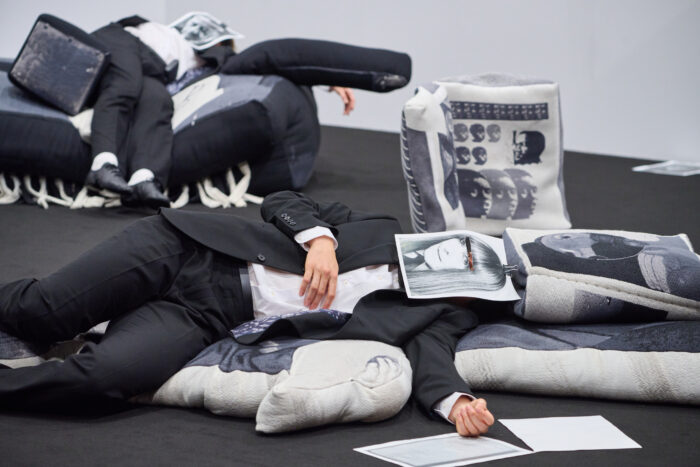
Kate MacGarry, Galerie Rüdiger Schöttle, in collaboration with Vistamare. Courtesy of Art Basel.
The first hall had a generous layout and a route that felt easy to follow. Visitors could move through it without worrying too much about missing something. That left more energy for looking.
The final hall offered a contrast. Spread across two floors, it contained an impressive amount of work but felt more like a maze. After several hours, the volume of images, objects and booths created visual fatigue. It became tempting to scan rather than engage.
This was not a question of the quality of the work. It was a reminder that attention is limited.
The way content is spaced, grouped and signposted affects what people are able to absorb. More choice can create discovery, but without enough structure, it can also encourage people to move on too quickly.
Designers often focus on the content itself. At Art Basel, it was clear that navigation and pacing matter just as much.
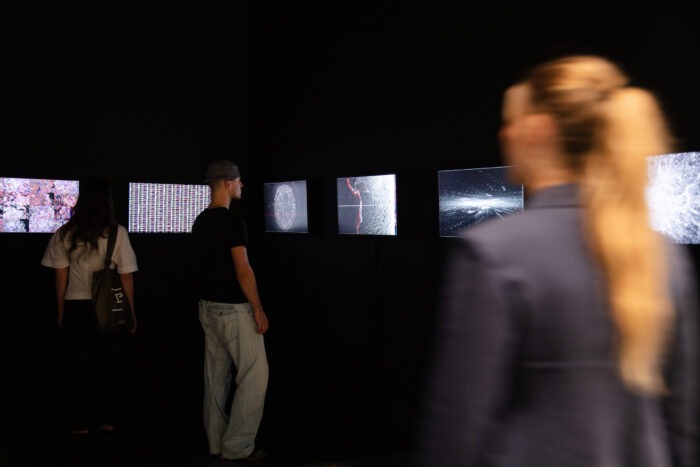
Zero 10
The most unexpected part of the day was Zero 10, Art Basel’s space for digital-era art.
Set apart from the main fair, it was quieter and smaller than the other spaces. Yet it was where visitors appeared to linger the longest.
The works did not rely on technology as spectacle. They gave people a role in the experience.
One circular screen gradually revealed a visitor’s face. Another transformed the bodies in front of it into shifting fields of coloured pixels. In a third work, a sensor picked up a person’s heartbeat and translated it into flashing bulbs and sound. A code-based piece generated an ongoing sequence of visual variations through colour, pattern and composition.
People were interested not only when they were taking part, but also when they watched someone else interact. The work became social. It created a small moment of curiosity and conversation between strangers.
That is what made the technology memorable. It did not remove the human element; it made human presence visible.
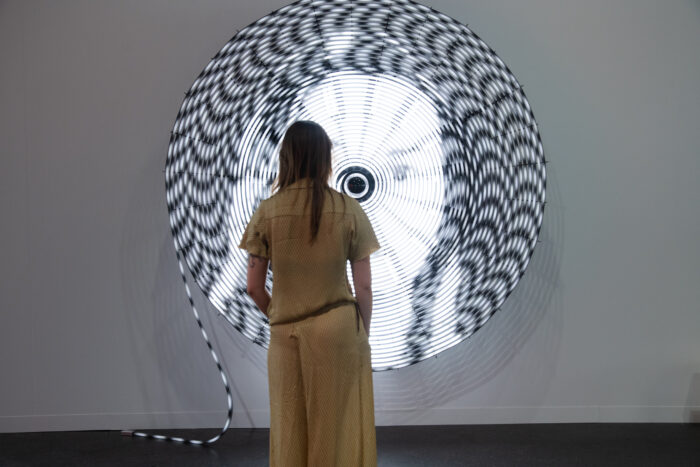
Visitors interacting with the work of Rafael Lozano-Hemmer. Courtesy of Art Basel.
An architect I spoke to said she attends events like this to encounter work in person. For her, the value is not only in a particular artist or trend. It comes from observing spaces, objects, patterns and the ways other creative people approach ideas.
Online, there is no shortage of visual inspiration. Yet a screen cannot fully reproduce scale, texture, sound, movement or the feeling of standing beside other people as they react to the same thing.
Art Basel showed that physical cultural spaces still offer something different: a shared place for curiosity.
Not every work at the fair was immediately understandable. Some looked raw, simple or unresolved at first glance. That was part of their value. A work does not need to be perfect or instantly obvious to invite a response. Sometimes its strength is in the question it leaves behind.
A reason to pause.
 The biggest lesson from Art Basel was not that creative work needs to be louder, more interactive or more visually complex.
It needs an invitation.
That invitation may come from an unexpected material, a story that changes how a piece is seen, a space that gives people time, or an experience that lets the audience become part of the work.
In a world where there is always more to scroll past, creating a reason to pause may be one of the most valuable skills a designer can have.
By the same author:
🧾 5 Sites to Spark Design Inspiration
Sources:
Images:
I help brands communicate ideas through visuals, stories and digital experiences.