Les professionnels de GBNews.ch s'allient à la puissance des technologies en intelligence artificielle générative, pour informer la communauté des affaires et le grand public, des dernières tendances et des évolutions du marché de l'emploi.

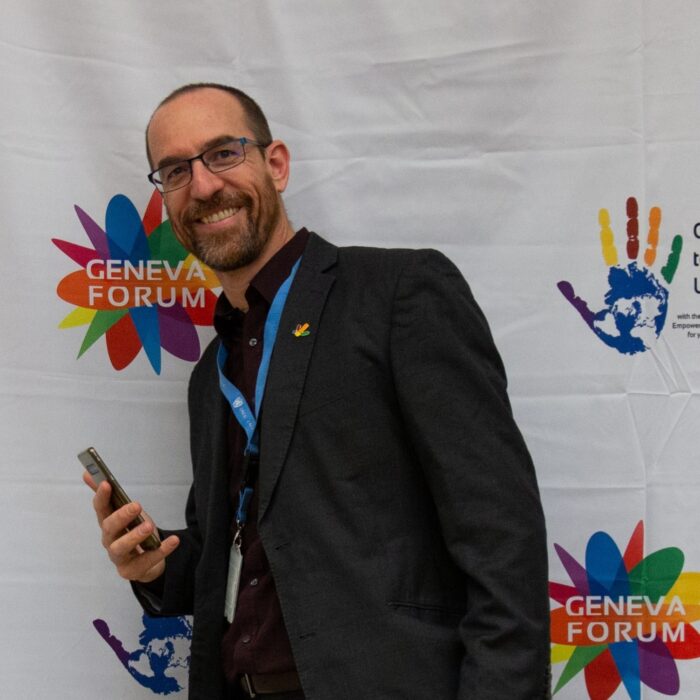
On Friday, March 27, 2026, I attended the second monthly workshop of the 2026 Global Impact Projects cycle at the Palais des Nations in Geneva. It was led by Thomas Egli, CEO of the Geneva Forum, an international platform he has led since 2001. The Forum brings together actors from finance, research, NGOs, business, and public institutions to help turn ideas into measurable, financeable impact projects.
Global Impact Projects are ambitious initiatives emerging from International Geneva. They aim to bring together international organizations, companies, NGOs, investors, and field operators around structural, mission-driven solutions that make International Geneva more readable and attractive.
In this interview, Thomas Egli reflects on his professional journey, the evolution of the Geneva Forum, and the practical tools he has developed to help mission-driven ideas become viable projects.
Mr Egli, could you share your professional journey and what inspired you to become CEO of the Geneva Forum and co-founder of the Geneva Foundation for the Future?
I began my professional life at 17 in science education. Without realizing it at first, we created what today would be called citizen science or participatory research: real research led by teenagers. That work brought me into contact with the University of Geneva and raised both practical and theoretical questions about how people understand complex ideas.
At the same time, between 1998 and 2000, I was approached by the French Embassy in Japan to export French know-how in science education. That experience highlighted a key problem: how could this kind of socially useful work become economically viable? Science education clearly had value, but it depended heavily on volunteers and uncertain subsidies.
That question led me to create the first Geneva Forum in 2001 as a one-week conference. The idea was simple: bring together professional spheres that normally never meet - scientists, financiers, private companies, NGOs, and international organizations. We quickly saw that these actors were not only interested, but willing to work together on concrete problems. The Forum grew from that need.
As for the Geneva Foundation for the Future, it came later from a similar observation: there are many serious, disruptive projects in the world, but without a viable economic model, they struggle to survive. At the same time, there is a great deal of capital looking for projects and unable to find them. The challenge was to align those two worlds.
The Geneva Forum has been running since 2001. What has been the biggest evolution you’ve seen in its role over the past 25 years?
One major change is that it was actually easier in 2001 to make different spheres intersect than it is today. Society has become more accelerated and more polarized. People speak a great deal about transversality, but in practice they stay more and more within their own circles.
This is visible even in response behaviour. In 2001, if we invited 1,000 people, 300 might come. Today, if we invite 10,000, perhaps 10 will come. That has forced us to become more focused. We do not communicate for the sake of communicating. We work quietly and protect the quality of the exchanges by making sure the right people are in the room.
In a sense, this evolution has made us stronger. We have returned to our core purpose: bringing together spheres that do not normally meet and helping transform ideas into real projects that can create jobs, revenues, and return on investment.
Can you share a real example of a project that has already moved from idea to bankable impact through the Geneva Forum process?
A strong example is Objectif Sciences International. When we created the Geneva Forum, the original question was how to develop an economic model that would allow scientific educators to be paid, rather than relying on volunteer work or unstable subsidies.
Over three years, we worked on that challenge, testing scenarios and business models until, in 2004, we found the model on which the NGO still operates today. It was a new approach. Even now, investors can support the NGO through private debt and receive a return on investment while backing a mission-driven project.
For me, this was both proof of concept for the Geneva Forum and an important breakthrough: it showed that it is possible to create a viable financial model around a socially useful mission.
In an article, you describe a paradox: enormous needs and trillions in available impact capital, yet very little of it reaches the UN system. How does AGILE impact finance tool bridge that gap?
The paradox is simple: on one side, a great deal of money exists and is looking for projects; on the other, many serious projects are looking for funding and cannot find it. These two worlds often do not meet, and even when they do, they do not speak the same language.
AGILE was designed to help solve that problem. It was developed over three years with representatives from many parts of the finance world, including banks, investors, and foundations in several countries. The goal was to create a tool that is simple enough for everyday use, but still strong enough to evaluate whether a project is mission-aligned, financially viable, and capable of generating return on investment.
Many existing tools are very complex and technical. AGILE is designed as a practical common language. It is currently in a 2026 crash-test phase with international organizations, NGOs, startups, and industrial actors. So far, it appears to be useful precisely because it is both simple and trusted.
Can you explain what role participatory research and citizen science play in the design of Global Impact Projects?
Participatory research can be very powerful because it is flexible and directly linked to real production. It is not just educational. It can help move solutions forward in concrete ways.
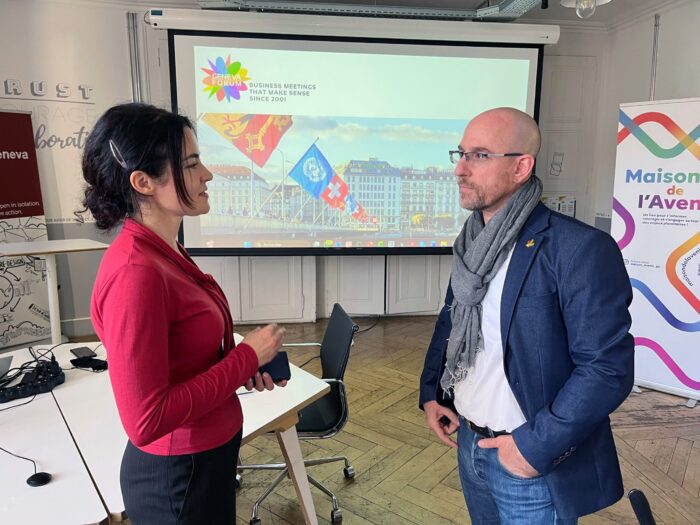
That makes it particularly useful for some Global Impact Projects, especially in areas such as water, ocean, or climate. It also helps create behavioural change, because citizens are involved in practical, transformative action.
That said, not every Global Impact Project uses participatory research. Some combine different formats, and some do not use it at all. The important point is that these projects are designed to go beyond silos and address several objectives through one activity.
What makes the Geneva Forum experience unique compared with other international conferences held at the Palais des Nations?
First, it genuinely connects very different spheres. In many conferences, doctors meet doctors, financiers meet financiers, and businesspeople meet businesspeople. At the Geneva Forum, people with very different professional languages and realities work together around the same project.
Second, it is not just about exchanging ideas. It is a process. People come for several days and work through the transformation of an idea into a project.
That is probably what makes it most unique: it is not just a marketing message. People arrive with an idea and leave with something much more concrete - a real project that can create jobs, generate value, and in some cases become a startup, a spin-off, or a major impact initiative.
What first sparked your passion for turning big ideas into real-world impact?
I have always been drawn to science, nature, and the human capacity to find solutions. Bringing those dimensions together makes it possible to build projects that are useful, mission-driven, and aligned with nature.
When I had to develop the entrepreneurial side of Objectif Sciences International, I faced very practical questions about management, resilience, organization, and business models. I found a great deal of inspiration in nature itself. Ecosystems and living systems offer highly effective models, refined through evolution, that can inspire more robust and adaptive organizations.
Between 1998 and 2001, this became clearer to me, and the publication of my book Les idées du vivant marked a turning point. From then on, I understood that my work was to help transform ideas into real projects, then into sustainable projects, and finally help them grow to another scale.
Over the course of 25 years, Thomas Egli has pursued a clear and consistent vision: building platforms where disconnected spheres can meet, communicate, and work together. His approach to aligning mission-driven projects with meaningful capital offers a thoughtful model for advancing systemic change in International Geneva and beyond.
By the same author:
🧾 UN Geneva Toastmasters: Empowering Inspiration, Leadership, Public Speaking, and Learning
🧾 De la protection à la participation : les avantages d’embaucher des titulaires de permis S
🧾 Le PAVE à Genève : la création de passerelles vers l'emploi pour les réfugiés
🧾 PAVE in Geneva: Creating Pathways to Employment for Refugees
🧾 From Protection to Participation: Employers Learn About the Benefits of Hiring Permit S Holders
🧾 How International Geneva Shapes Global Governance
Professionnelle multilingue avec une expérience internationale dans le soutien aux cadres supérieurs dans divers secteurs.