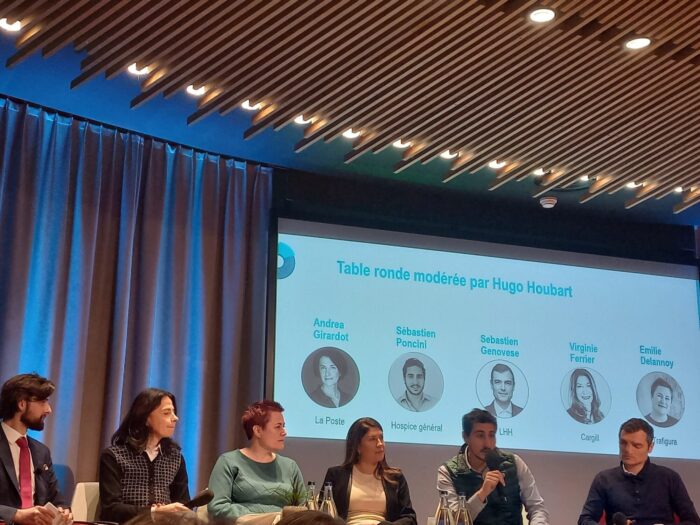
From Protection to Participation: Employers Learn About the Benefits of Hiring Permit S Holders
On January 13 at FER Genève, over 150 employers and HR leaders met to discuss how Permit S... En lire plus


Lean Management is a fundamental principle: every business activity must create value for the end customer (in this case, the employee and the organization).
Processes that generate more administrative burden than benefits create waste. The PDCA cycle (Plan-Do-Check-Act) allows us to continuously measure, and therefore improve, effectiveness.
I participated in implementing HRIS (Human Resources Information System) software coupled with a ticketing system, originally designed for a large hub with lots of staff and HR teams.
Our context was radically different: limited structure, and a reduced HR team. The system automatically generated tickets for each micro-action in the HRIS. In practice, we handled employees' actual requests efficiently, but we didn't have time to manually close all these administrative tickets.
The result: KPIs displayed chronic delays and triggered red flags with the central hub, while the real HR work was accomplished. Thus, there was a big mis-match: our indicators measured our ability to do ticket administration, not our real contribution to employees and the organization.
By applying Lean principles, I conducted a comprehensive analysis of the value chain design. This required in-depth investigative work: mapping the entire ticketing system, identifying which buttons and processes in the HRIS automatically generated tickets, and engaging with different business process owners and users to understand concrete impacts. This analysis enabled me to propose a complete redesign of the architectural system for ticketing. The new architecture eliminated non-value-added tasks, while maintaining the relevance of performance indicators. As a result, the time the team previously spent on administrative ticket management could be reinvested in actual employee support—where the real HR added value lies.
Are your tools and processes sized for your actual context? How much time does your team spend on administrative tasks which have no HR added value?
Announcement: Article 5 - Final chapter: the 6 pillars of human-centered HR digitalization and 3 key questions to transform your processes now.
By the same author:
Change Management and Business Continuity: Reorganizing While Preserving the Human Dimension
Repenser les RH : participez à TruGeneva 2025 à Genève
Gestion du changement et continuité des activités : réorganiser sans perdre l'humain
Processes Yes, Rigidity No: The Agility Imperative
Processus oui, rigidité non : l'impératif d'agilité
HR Processes in the Digital Age: Balancing Automation, Humanity, and Agility
Processus RH à l'ère de transformation digitale : entre automatisation et humanité, comment rester agiles ?
Image source: Dilok Klaisataporn via iStock

Titulaire d'un Master en Psychologie du Travail et des Organisations et certifiée CAPM, j'accompagne depuis 13 ans les organisations à travers divers secteurs—du CICR au secteur bancaire, du trading aux cabinets d'audit—dans leurs transformations, leurs opérations RH et programmes de bien-être et de cohésion d'équipe. En tant que HR Operations Manager, j'ai développé une approche unique alliant rigueur académique et pragmatisme opérationnel. Cette double perspective m'a permis de comprendre les dynamiques humaines au-delà des apparences tout en restant ancrée dans l'action concrète. Je suis convaincue que les meilleures organisations sont celles qui placent l'humain au centre, non pas comme un slogan, mais comme une pratique quotidienne.