Les professionnels de GBNews.ch s'allient à la puissance des technologies en intelligence artificielle générative, pour informer la communauté des affaires et le grand public, des dernières tendances et des évolutions du marché de l'emploi.

Agenda

Quel froid ! ...

Du 13 novembre 2025 au 30 août 2026

Le futur, c’est ...

Du 7 mai 2026 au 10 janvier 2027

À l’ombre des ...

Du 3 juin 2026 au 11 avril 2027

CinéTransat 2026 : ...

Du 9 juillet au 16 août 2026

Aubes Musicales 2026 ...

Du 13 juillet au 16 août 2026

LinkedIn Is Changing How It Evaluates Posts. The “Seems like AI slop” Button Is Only Part of a Bigger Change

Écrit par Nina Maksymova
Paru le 14 août 2026

linkedin post

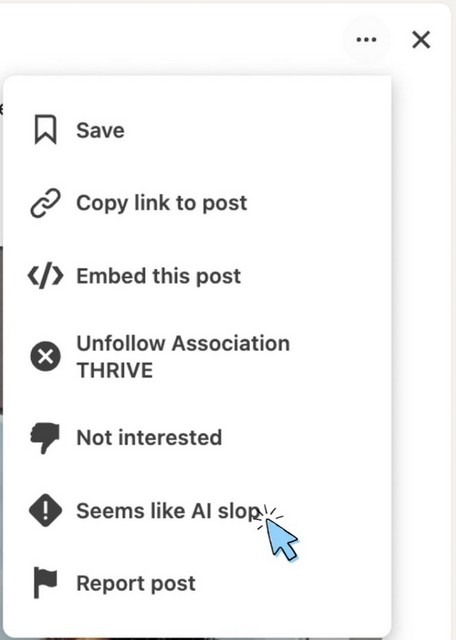
LinkedIn is changing the way it evaluates posts. The “Seems like AI slop” button is probably only the visible part of a bigger change. I started looking at this differently when I reviewed my own scheduled posts.

The platform seems to be trying to better distinguish content that brings real value from content that is too generic. In the long term, this could affect content visibility and the way LinkedIn decides which posts to show to more people. And for anyone who uses LinkedIn professionally, visibility is not a small detail.

If you regularly publish on LinkedIn, this change is probably worth paying attention to.


Why this caught my attention

I usually prepare my LinkedIn posts several weeks in advance.

The latest LinkedIn changes made me realise that it might be time to look at my scheduled posts more carefully.

Why?

Because LinkedIn is changing the way it evaluates posts.

LinkedIn does not seem to be against using AI. But the platform increasingly wants to highlight content that provides real value.

And I can understand why.

I have noticed this quite often over the past few months. My feed has become full of AI-generated content that feels impersonal and interchangeable.


How does LinkedIn seem to evaluate posts?

In practice, this means that simply producing a well-formatted post may no longer be enough.

A post can be flagged in several ways:

  • A user clicks the “Seems like AI slop” button. In this case, the post is hidden from that person. This signal is also used to train LinkedIn’s models. In the future, it could also affect the reach of the post. LinkedIn is also planning to notify the post’s author that it has been flagged, but this feature is still being developed.
  • Machine learning models analyse different signals, including feedback from users and LinkedIn’s editorial teams.
  • A human review can also be part of the process.


So, what kind of content are we talking about?
  1. A post without a personal point of view.
  2. The same ideas repeated again and again.
  3. A lack of context.
  4. A very generic style: obvious statements, repetitive structures and advice that could apply to almost anyone. For example: “Be consistent”, “Know your audience”, “Create valuable content.” That’s correct. But what does this really mean for a small business in Switzerland?
  5. Content being produced and published on a very large scale.

This is probably the point I would pay the most attention to.


Another change that is easy to miss

There is another change that caught my attention. LinkedIn is gradually removing the “Enhance your post” feature - the tool that used to rewrite posts.

Instead, LinkedIn is introducing a proofreading tool that corrects the text without changing the author’s style.

Personally, this confirms an idea I already had: AI can help you write. But it should not write for you.


What does this change for content creators?

If you are preparing your next post, here is what I would ask myself first: “What can I add that AI has no answer for”.

  1. Talk about your own experience.
  2. Share real examples.
  3. Add data when you have it.
  4. Keep your own way of writing.
  5. Share your professional observations.
  6. And, most importantly, give your own conclusions.


What I take from this

In my opinion, this change is going in the right direction.

I agree: AI is a great assistant. I use it myself to do research, structure my ideas and check wording across languages. For me, that means the examples, observations and conclusions should come from my own work, not from a prompt.

In the end, perhaps the real question is not whether a post was written with the help of AI. The question is whether it contains something that only its author could have shared.

I don't ask AI to write my posts from scratch. I usually bring my own ideas and observations first, and use AI to help me structure or refine them.

You can find the French version here: LinkedIn


By the same author:

Part Two - How AI Is Reshaping SEO: What Businesses Need to Know Now
Part One - How AI Is Reshaping SEO: What Businesses Need to Know Now
Pourquoi les campagnes Google Ads échouent en Suisse et comment les faire fonctionner
Why Google Ads Campaigns Fail in Switzerland - And What to Do About It
Réflexions sur l'atelier Google Ads : stratégie, structure, localisation
Google Ads Workshop Reflections: Strategy, Structure, Localization

Nina Maksymova

I analyse projects, including contextual advertising audits. I identify weaknesses and highlight opportunities you may not even be aware off.

Articles connexes :

Laisser un commentaire

Votre adresse e-mail ne sera pas publiée. Les champs obligatoires sont indiqués avec *

Ce site utilise Akismet pour réduire les indésirables. En savoir plus sur la façon dont les données de vos commentaires sont traitées.

linkedin facebook pinterest youtube rss twitter instagram facebook-blank rss-blank linkedin-blank pinterest youtube twitter instagram
Résumé de la politique de confidentialité
GBNews.ch | Actualités: Emploi, RH, économie, entreprises, Genève, Suisse.

Ce site utilise des cookies afin que nous puissions vous fournir la meilleure expérience utilisateur possible. Les informations sur les cookies sont stockées dans votre navigateur et remplissent des fonctions telles que vous reconnaître lorsque vous revenez sur notre site Web et aider notre équipe à comprendre les sections du site que vous trouvez les plus intéressantes et utiles.

Cookies strictement nécessaires

Cette option doit être activée à tout moment afin que nous puissions enregistrer vos préférences pour les réglages de cookie.

Cookies tiers

Ce site utilise Google Analytics pour collecter des informations anonymes telles que le nombre de visiteurs du site et les pages les plus populaires.

Garder ce cookie activé nous aide à améliorer notre site Web.