
Before the Project, There Is the Person
Leadership isn't a professional strategy—it’s a way of life. Explore how personal integrity and care drive project success... En lire plus

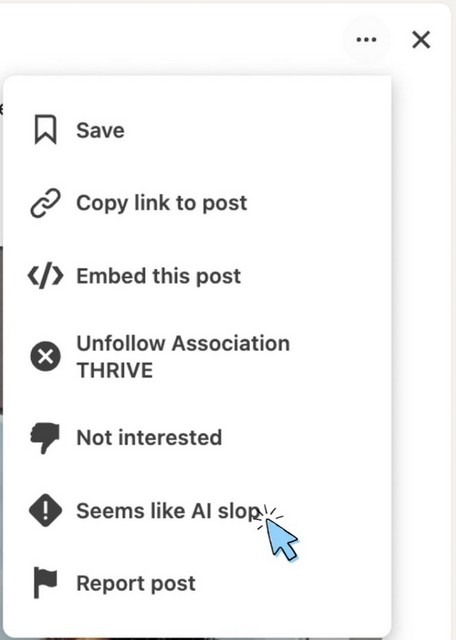
LinkedIn is changing the way it evaluates posts. The “Seems like AI slop” button is probably only the visible part of a bigger change. I started looking at this differently when I reviewed my own scheduled posts.
The platform seems to be trying to better distinguish content that brings real value from content that is too generic. In the long term, this could affect content visibility and the way LinkedIn decides which posts to show to more people. And for anyone who uses LinkedIn professionally, visibility is not a small detail.
If you regularly publish on LinkedIn, this change is probably worth paying attention to.
I usually prepare my LinkedIn posts several weeks in advance.
The latest LinkedIn changes made me realise that it might be time to look at my scheduled posts more carefully.
Why?
Because LinkedIn is changing the way it evaluates posts.
LinkedIn does not seem to be against using AI. But the platform increasingly wants to highlight content that provides real value.
And I can understand why.
I have noticed this quite often over the past few months. My feed has become full of AI-generated content that feels impersonal and interchangeable.
In practice, this means that simply producing a well-formatted post may no longer be enough.
A post can be flagged in several ways:
This is probably the point I would pay the most attention to.
There is another change that caught my attention. LinkedIn is gradually removing the “Enhance your post” feature - the tool that used to rewrite posts.
Instead, LinkedIn is introducing a proofreading tool that corrects the text without changing the author’s style.
Personally, this confirms an idea I already had: AI can help you write. But it should not write for you.
If you are preparing your next post, here is what I would ask myself first: “What can I add that AI has no answer for”.
In my opinion, this change is going in the right direction.
I agree: AI is a great assistant. I use it myself to do research, structure my ideas and check wording across languages. For me, that means the examples, observations and conclusions should come from my own work, not from a prompt.
In the end, perhaps the real question is not whether a post was written with the help of AI. The question is whether it contains something that only its author could have shared.
I don't ask AI to write my posts from scratch. I usually bring my own ideas and observations first, and use AI to help me structure or refine them.
You can find the French version here: LinkedIn
Part Two - How AI Is Reshaping SEO: What Businesses Need to Know Now
Part One - How AI Is Reshaping SEO: What Businesses Need to Know Now
Pourquoi les campagnes Google Ads échouent en Suisse et comment les faire fonctionner
Why Google Ads Campaigns Fail in Switzerland - And What to Do About It
Réflexions sur l'atelier Google Ads : stratégie, structure, localisation
Google Ads Workshop Reflections: Strategy, Structure, Localization

I analyse projects, including contextual advertising audits. I identify weaknesses and highlight opportunities you may not even be aware off.