
OCDE – IA au travail: perceptions positives, craintes sur l’emploi et les salaires
Enquête OCDE : IA au travail perçue positivement, mais les salariés s’inquiètent pour l’emploi et les salaires, avec... En lire plus

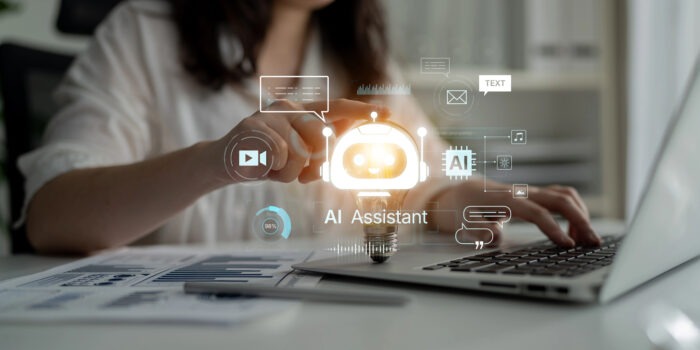
Artificial intelligence has, in just a few years, become embedded in both our professional and personal lives. In the fields of communication and marketing, tools based on language models are now used daily to generate ideas, structure content, translate texts, and analyse large volumes of information.
The question is no longer whether AI will transform the way we work. The real issue is this: to what extent will this evolution reshape communication professions – and how effectively and responsibly professionals will use it?
Since the emergence of large language models (LLMs), AI capabilities have become clearly visible to the general public. Tools such as ChatGPT, Gemini, Claude, and Perplexity now make it possible to generate text, summarise information, or assist content production within seconds.
In the creative field, other solutions like Midjourney, DALL·E, and Adobe Firefly are also opening up new possibilities for visual creation.
These tools provide near-instant access to a vast body of knowledge and can accelerate many editorial processes, including research, article structuring, multi-channel adaptation, and translation.
However, these impressive performances can also create a misleading illusion: that of an intelligence capable of replacing human thinking.
Despite its many capabilities, one fundamental reality must be emphasised: language models do not “understand” information in the human sense.
They analyse linguistic probabilities based on massive datasets and generate statistically plausible responses. This allows them to answer questions and produce coherent text – but not necessarily in a way that is accurate, relevant, or suited to a specific context.
In other words, AI has no intention, no judgment, and no strategic understanding.
This is precisely why using AI requires a clear framework, a sound methodology, and human oversight.
In communication, the quality of the output depends directly on the quality of the input and the context provided. The well-known principle of Garbage in, garbage out (GIGO) applies here as well: when the initial data is imprecise, biased, or poorly structured, the results will inevitably reflect those flaws.
One often underestimated challenge in the use of AI tools concerns the management of sensitive data.
When employees use online platforms to generate content, they may be tempted to include internal information: marketing strategies, customer data, confidential documents, or ongoing projects.
However, such information may be stored or used to train AI models, depending on the providers’ terms of use.
Within a regulatory environment shaped in particular by the General Data Protection Regulation (GDPR) in Europe and the Federal Act on Data Protection (FADP) in Switzerland, companies and communication professionals must remain especially vigilant about protecting both personal and professional data.
This raises several important questions:
Beyond legal considerations, there is also a strategic issue: if the same tools are used by everyone with the same public data, the content produced risks becoming increasingly standardised.
Yet for brands and content creators, differentiation and originality remain essential.
In any editorial process, the effectiveness of AI depends above all on the quality of the briefing provided – the prompt – that is, the context and role assigned to the AI when formulating a request.
Clearly defining the situation, objectives, target audience, editorial tone, and specific constraints leads to far more relevant results.
This approach is crucial, but it is far from new for communication professionals. Strong content has always relied on a well-crafted brief and a clear overall vision.
AI does not replace strategic thinking at the outset. On the contrary, it makes it even more essential.
The idea that AI could replace communication professions is often oversimplified.
Certain operational tasks can indeed be automated or accelerated. However, the elements that define the value of these professions remain deeply human: understanding audiences, strategic vision, creativity, critical thinking, and editorial responsibility.
Professional experience, in-depth knowledge of a sector, and mastery of language remain essential to producing truly accurate and relevant content – whether for an article, a campaign, or a translation.
Used intelligently, AI can become a powerful working assistant: a tool that helps generate ideas, structure them, explore new angles, or synthesise information.
But the overall direction, coherence, and relevance of messages should remain in the hands of professionals.
The integration of artificial intelligence into communication processes, therefore, does not mean the disappearance of professional skills. On the contrary, it highlights their importance.
To use these technologies effectively, it is necessary to understand both their strengths and their limitations. This involves developing a rigorous methodological approach, applying a critical perspective to generated content, and being able to assess its quality and relevance in relation to an overall strategy.
AI can produce text and content quickly. However, it cannot replace the expertise of a professional capable of understanding a market, an audience, and a brand’s challenges.
AI will undoubtedly continue to evolve and transform certain aspects of work. But its impact will largely depend on how we choose to use it.
Rather than viewing these tools as a miracle solution or, conversely, as an absolute threat, it is more useful to see them for what they truly are: amplifiers of human capabilities.
In the right hands, they can improve efficiency and open up new perspectives. Used without reflection or strategy, however, they above all risk producing generic content, diluting the strategic value of communication, and in the worst cases, creating serious reputational and economic issues.
In a world where information can be generated in seconds, real value lies more than ever in the ability to think, to contextualise, and to make decisions. And for now, that remains a profoundly human skill.
By the same author: Intelligence artificielle : quel rôle dans les métiers de la communication ?
Image: depositphotos.com

Passionnée par les langues et les mots, j’ai construit mon parcours dans le marketing et la communication, en développant des contenus et des stratégies multicanales dans plusieurs langues. Aujourd’hui, je fais évoluer cette expertise vers l’écriture rédactionnelle, avec une envie forte : explorer, comprendre et transmettre. Je m’intéresse particulièrement aux sujets à la croisée de la culture, de la nature et des transitions actuelles – qu’elles soient écologiques, technologiques ou sociétales. D’un naturel curieux, j’aime creuser, questionner et mettre en perspective. Formée également à l’intelligence artificielle, j’aborde ces évolutions avec un regard à la fois informé et critique, attentive à leurs implications humaines et environnementales. À travers mes articles, je cherche à proposer une lecture accessible, nuancée et ancrée dans le réel des enjeux actuels.