When Brands No Longer Need Cameras: AI and the Future of Brand Storytelling
AI is enabling organisations to create polished promotional videos without cameras, studios or large production teams. As technical... En lire plus

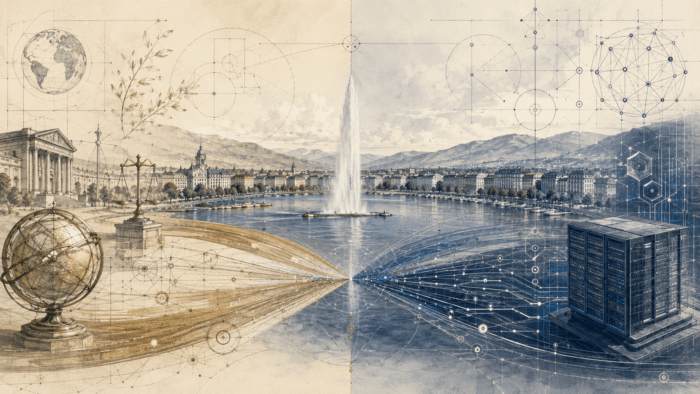
Three overlapping gatherings in Geneva in July 2026: can AI governance become more than a calendar of speeches before Switzerland’s 2027 AI summit?
Artificial intelligence is often presented as the next shared project of humanity. It is increasingly behaving like the next strategic border.
Governments still speak about safety, ethics and innovation. But the harder argument is already moving underneath: who will gain access to the most capable models, the computing power behind them and the standards that decide how they can be used?
That is why Geneva’s most important AI moment may not be the summit planned for the first half of 2027. The first real test comes in July 2026.
This is not just a rehearsal for 2027. It is the first real test of AI governance.
These are separate events, with different organizers, mandates and expected outputs.
But together they bring three layers that usually operate in parallel into one week: the UN’s political legitimacy, the wider implementation agenda for digital cooperation and the ITU’s technical machinery.
Switzerland’s Federal Council says the July cluster should strengthen the link between technical discussions and public-policy debate. The question is whether Geneva can turn that rare institutional overlap into a process with owners, review points and consequences before the 2027 summit.
The last four AI summits were not failures. Each moved the conversation forward. But each also exposed a different gap between a political announcement and a working system.
Taken together, these summits show progress. They have created vocabulary, institutions, investment signals and wider participation. What they have not yet created is an operating model that survives the closing speeches.
The recurring gap is simple: commitments are announced before anyone is clearly responsible for delivering them. There is often no public metric, no review date and no agreed consequence when a promise becomes inconvenient.
That is the gap Geneva must close before 2027.
Think of the current AI race in three steps.
The real jump is not from a faster answer to a better answer.
It is from an answer to an outcome.
One of the first major stones that helped start this avalanche was Ilya Sutskever.
In 2012, he co-authored AlexNet, a breakthrough that helped prove large neural networks trained on powerful graphics chips could outperform older systems. AlexNet did not create LLMs by itself. But it helped make the modern AI boom technically believable.
Sutskever’s new company, Safe Superintelligence Inc., says “superintelligence is within reach”.
OpenAI is planning for the same direction from another angle: an automated AI researcher, AI systems helping to accelerate research itself and, eventually, “personal AGI”.
These are corporate positions, not neutral forecasts.
But they create a governance problem that diplomacy cannot ignore.
A summit agenda written as a fixed document in 2026 may be outdated by the time Geneva opens in 2027.
The issue is not whether every dramatic claim from a lab will prove right. It is whether the process has built-in update points for new capabilities, deployment patterns and security risks before they outrun the next declaration.
AI governance is becoming a contest over access, leverage and infrastructure: who gets the most capable systems, who sets the conditions and who has to live with rules designed elsewhere.
In June, Reuters reported that G7 leaders discussed a possible “trusted partners” arrangement for access to advanced AI models developed by U.S. firms. The idea may never become a formal regime. It already matters because it shows how quickly access to frontier capability can become a question of security, alliances and political trust.
The United States and its frontier-lab ecosystem increasingly operate at the intersection of national security, commercial leadership and trusted-partner access.
The EU brings binding rules, rights language and an ambition to shape the technical conditions under which AI systems operate.
China’s 2025 Global AI Governance Action Plan combines global solidarity and support for Global South access to AI infrastructure with national sovereignty, open cooperation and standards influence.
India and many other countries are asking a different question: who will have the computing power, systems that work in local languages and the practical ability to deploy AI rather than merely consume it?
These positions do not divide neatly into good and bad camps. They are competing answers to a shared fear: becoming dependent on infrastructure, models and rules designed elsewhere.
Every serious participant will arrive with a Best Alternative to a Negotiated Agreement (BATNA): its fallback plan if no deal is reached.
Geneva’s task is to find a Zone of Possible Agreement (ZOPA): the narrow overlap where actors can still cooperate without pretending that their red lines have disappeared.
Switzerland has real assets. The 2027 summit will be jointly organized by DETEC and the FDFA. The Federal Council says it will work with academia and the private sector, using International Geneva to put international law and fundamental rights visibly into the debate on AI development and deployment.
Geneva can bring together what most capitals do not have in one operating environment: the UN’s universal political table, the ITU’s technical machinery, standard-setting expertise, research networks, humanitarian actors and the businesses that will deploy the technology.
That can make the city useful.
Neutrality does not create shared access to compute, independent evaluation capacity, representative participation or compliance. It cannot compel major powers to share frontier capabilities. And it does not turn voluntary promises into work that survives the closing photograph.
The Swiss test is therefore practical: can Geneva connect the rooms that already exist, give each handover an owner and a date, and make progress visible enough that commitments cannot quietly disappear once the summit ends?
For organizations in education, humanitarian response, research, public services and business, the opportunity is broader than a keynote slot.
July is a chance to test alliances, put evidence into the room, identify who can move a problem and place an idea on a route that may later become policy, a standard, a workstream or a public commitment.
A good intervention is not a polished statement. It is a proposal with a mechanism, an owner and a next step.
If you cannot answer these five questions, you do not yet have a position. You have a concern.
“If organizers cannot pass these tests, they have a programme. Not a governance pipeline.”
There is something uncomfortable about a point made by the fictional Professor Moriarty to Sherlock Holmes: "once conflict becomes an ecosystem, one actor can profit from weapons, another from finance, another from supplies — while someone else inherits the consequences."
It is fiction. That is exactly why the similarity is, in the language of official statements,
“a matter of serious concern.”
The analogy should not be abused. AI competition is not an inevitable war.
But the warning is useful. The same ecosystem can build models, rent cloud capacity, sell cyber-defence, provide compliance tools and benefit from the security logic that restricts access to all of them.
A pleasant summit photo cannot resolve that.
Competition is not the enemy. Permanent dependency is.
The alternative is not naïve harmony. It is enough shared discipline to stop competition over AI from turning into exclusion, unmanaged risk and rules written by a small group for everyone else.
Earth is not a set of separate operating zones. Compute may sit in different jurisdictions, but its economic, environmental and security consequences do not.
Geneva will not settle the future of AI in July. But it can show whether the 2027 summit is being built as another event — or as a process strong enough to survive the world outside the room.
The next frontier should expand humanity’s room to cooperate, not simply give old rivalries new terrain…
By the same author: 🧾 For Geneva NGOs, Ambiguity Has Become Too Expensive
Image: OpenAI
Sources:

When work gets stuck between people, priorities, deadlines and unclear decisions, I help bring it back to execution.