
Depuis vingt ans, la HES-SO surprend les festivaliers de Paléo
Depuis vingt ans, la HES-SO surprend les festivaliers de Paléo avec des installations immersives imaginées par plus de... En lire plus


AI may make structured strategic thinking accessible to organisations that never had access to it before.
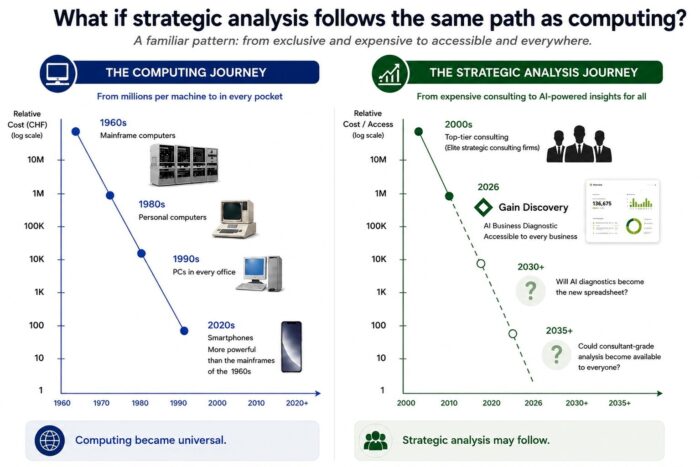
There is a familiar pattern in technology.
Capabilities that begin as expensive, specialised, and available only to large institutions often become dramatically more accessible over time. Computing followed this path. In the 1960s, mainframe computers cost millions and were owned by governments, universities, and large corporations.
By the 1980s, personal computers were entering offices and small businesses.
Today, smartphones pack more computing power than many of the era's mainframes and fit in nearly every pocket.
The question is whether strategic analysis may follow a similar path.
For decades, high-quality financial and operational analysis generally belonged to organisations with the budget to hire top-tier consultants, specialist advisors, or large internal finance teams.
A serious strategy or cost optimisation engagement from an elite consulting firm can run into the hundreds of thousands of francs, and sometimes far more. For a multinational, a global bank, or a government institution, that may be a rational investment.
However, for most SMEs, NGOs, family businesses, and local organisations, it is not a realistic starting point.
This is not a criticism of consulting firms. Quite the opposite. The reason they are valuable is that strategic judgment is difficult. Good consultants combine analysis, sector knowledge, interviews, benchmarking, stakeholder management, and implementation discipline. That work deserves respect.
But the economy has created a gap.
Some organisations can afford structured strategic thinking. Many others cannot. They may have financial data, operational experience, and real opportunities for improvement, but no practical way to turn that information into a structured view of where to save, where to grow, or what to fix first.
For most of the digital era, software helped organisations organise information rather than interpret it. Accounting systems, spreadsheets, ERP platforms, and dashboards became essential tools, but they still depended on human experts to ask the right questions. The difficult part was never simply storing the numbers. It was understanding what they implied.
Where are costs unusually high?
Which processes are slowing the organisation down?
Which growth opportunities are being missed?
Which actions are worth investigating first?
Large language models have changed expectations around these questions. They can read business context, reason across categories, draw on general knowledge of operational patterns, and produce structured recommendations in minutes.
The output still requires judgment and verification. But it can give organisations something many of them never had before: a useful analytical starting point.
That is the space Gain Discovery is exploring.
Gain Discovery is an AI-powered business diagnostic tool designed to help users identify potential savings, growth opportunities, and process improvements. A user can upload a financial document, enter basic information, or simply describe a situation without sharing sensitive data. The more detail provided, the more specific the analysis can become, but the starting point does not require a full data room, onboarding process, or consultant workshop.
The goal is not to produce a final board-level consulting report. It is to replace the blank page.
For a small business owner, NGO manager, freelancer, or household, the hardest step is often knowing where to begin. A structured diagnostic can highlight hypotheses: supplier consolidation, better purchasing discipline, banking cost reviews, subscription rationalisation, improved credit control, workflow automation, new pricing opportunities, or operational bottlenecks.
Some ideas may be immediately useful. Others may need to be reviewed, challenged, or refined with a fiduciary, accountant, lawyer, broker, supplier, or industry specialist.
That is by design. Gain Discovery treats AI-generated recommendations as starting points, not conclusions. They help the user see where to look next.
AI can help more people reach the point where expert advice becomes focused and productive.
In this sense, the better analogy may not be “AI as a consultant”, but “AI as a spreadsheet”.
Spreadsheets made financial work more accessible, while making expert judgment more valuable in the places where it mattered most. They allowed millions of people to model, compare, estimate, and plan before deciding where specialist advice was needed. Over time, they became invisible infrastructure.
AI diagnostics may follow a similar path. Today, they can generate first-pass analyses. Tomorrow, they may support continuous monitoring, live benchmarking, scenario modelling, implementation planning, and feedback loops that track whether recommendations actually produced value.
Could consultant-grade analysis eventually become available to every organisation?
Nobody knows. And it would be naive to pretend that software alone can replicate the full work of the best human consultants. But it would also be naive to ignore the direction of travel. Ten years ago, few people would have believed that an AI system could read a business document, identify operational inefficiencies, suggest growth initiatives, and draft an action plan in seconds. Today, as a first pass, that is already possible in early form.
The important word is “early”.
Gain Discovery is still at the beginning of that journey. It is a beta product, and its recommendations should be independently checked before financial, legal, tax, or operational decisions are made.
But early does not mean insignificant.
A first diagnostic does not need to be final to be useful. If it helps an organisation identify one overlooked cost, one inefficient process, or one growth opportunity worth exploring, the value can exceed the cost of access many times over. The ambition is not to overpromise. It is to make useful analysis cheap enough, fast enough, and simple enough that more organisations can afford to start.
For Geneva, this matters.
The city is home to global institutions, banks, NGOs, family businesses, independent professionals, and ambitious SMEs. Some already have access to world-class advisors. Many others do not. If AI can help close even part of that insight gap, it can strengthen the entire local business ecosystem rather than weaken it.
The future may not be that every business needs to hire a McKinsey consultant.
It may be that every business gains access to a first layer of structured strategic thinking — the kind of thinking that helps people ask better questions, use expert advice more effectively, and make more informed decisions.
Computing became universal.
Strategic analysis may follow.
Gain Discovery is currently inviting early users to try the platform and help shape its development. As part of the beta, 50 Geneva Business News readers can use promo code GBNREADERS50 to receive complimentary access to the Basic plan for their first billing period at gaindiscovery.com.
AI-generated recommendations should be independently reviewed before financial, legal, tax, or operational decisions are made.
By the same author:
🧾 The Rise of AI in Infrastructure: Why Stronger Safety Measures Are Essential
Image: Depositphotos

De la conception à la production, je fournis des systèmes fiables et évolutifs avec une complexité réduite et des coûts optimisés.