
How to improve back office efficiency
The back office acts as the backbone of a company. How can a company increase, therefore, the efficiency... En lire plus

The first article in our series on planning addresses time management. This aspect of planning is essential because:
We cannot manage time without planning. But before we focus on how to manage time through planning, it is essential to ask these questions: What are my objectives and priorities? What do I ultimately want to achieve?
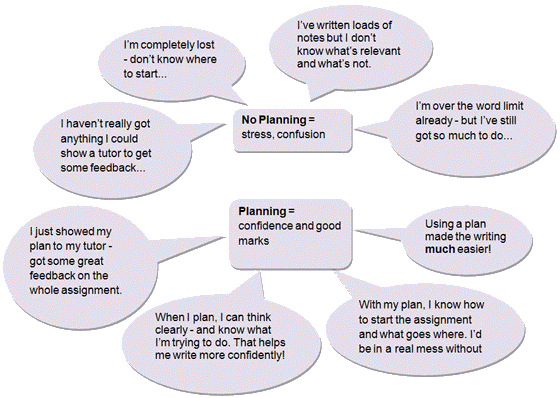
Planning defines what we hope to achieve in a given period of time. You may know the following phrase:
"If you fail to plan, you are planning to fail.” --Benjamin Franklin
Planning has three fundamental steps :
The advantages of doing so are, among others:
To plan is to think, to determine what we want, and to make a commitment to make it happen.
The "what" is to plan. The "how, when and with what means" is the programming.
A program is a planned series of events, a 'booklet' telling you what events to expect as part of a series of events.
Programming needs to be done in order to:
For an individual, programming should include professional and personal activities, taking into account that we must leave some time for the unforeseen occurences that arise daily.
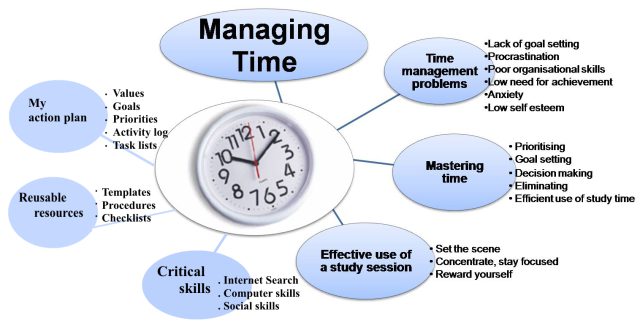 Planning and programming should be as agile and flexible as the work and personal style of each person allows. It is essential to decide what you want to achieve and what activities are necessary. Then, it is easier to determine what resources are needed and at what milestones for the activities should be initiated or completed.
Time programming is an activity that must end up being habitual and daily. Acquiring effective scheduling habits will make it easier and more comfortable. Establishing a daily program is one of them. Always have your program prepared before starting the day.
The easiest way to do this is to dedicate the last few minutes of the previous day to programming the next day’s activities. Starting your day’s work with concrete activities helps productivity, and ensures you are not reacting like a firefighter all day (putting out the fire).
Here are a few tips for effective programming:
- Schedule the activities according to the objectives you want to achieve
- Try not to count the activities, but the results obtained
- Develop your program around the essential issues
- The rest of your programming can be completed with activities of minor importance
- Program the most important things to do in the hours in which you have more energy and you are more effective
- Put your schedule in writing
- Group actions and related matters with each other whenever possible
- Assign sufficient time to complete each activity
- Program a time to think every day, since this will help you focus on your goals
- Place your program in a visible place, since this will help you to stay in line with your objectives
- Avoid being interrupted
To program the time it is useful to do a detailed time analysis.
Make a written record of your activities the time each of them takes for two weeks. Then, you will:
This detailed time analysis will allow you to:
Once you have set your priorities, the next step is to plan and organize your time.
The three rules of daily programming are:
Here is an example of how you can plan your day in five minutes:
- FIRST MINUTE: Finish today’s tasks. Check actions of the day, and that all prevous tasks have been carried out. If not, transfer actions to the next day.
- SECOND MINUTE: Check tomorrow’s appointments (calendar). Make a quick reminder of meetings and engagements dated for the next day (these are usually dated in advance).
- THIRD MINUTE: Determine the time for appointments (daily plan). Reserve time in the daily plan for meetings or commitments dated in advance. Book travel times and all those activities that are unavoidable.
- FOURTH MINUTE: List actions or activities to be carried out (actions).
- FIFTH MINUTE: Determine the time for actions we must do that day (daily plan).
To summarize
Plan. And, above all, program your tasks according to your objectives. Perform the scheduled tasks. It's no use planning if you do not do it later. Take control. Determine indicators to estimate if you will achieve the objectives with this planning, or if, on the contrary, it is necessary to make some modifications.
Next in the series - How to define a goal and an objective?
Information sources:
http://agreatdayswork.com/tag/time-management/
http://www.library.dmu.ac.uk/Support/Heat/index.php?page=478
https://galwaymathsgrinds.wordpress.com/2014/09/23/time-management-for-students/
Image credit : CC Public Domain License