
995 Concept
995 Concept est un espace à Genève qui réunit un café, une offre vinicole nature et une sélection... En lire plus

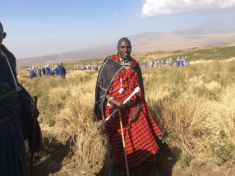
Arpakwa Sikorei
Continuing our journey exploring career goals, I had the pleasure interview Mr Arpakwa Sikorei.
Sikorei is from the Ngorongoro region in Tanzania. He worked at the United Nations Educational Scientific and Cultural Organization (UNESCO) for many years as a program assistant, and was involved in the project, “People and Wildlife; Past, Present and Future in the Ngorongoro Conservation Area World Heritage Mixed Site.”
The Ngorongoro Conservation Area is a UNESCO World Heritage site. Located in Tanzania and established in 1959, the project has three main objectives:
The area is managed by an autonomous organization called Ngorongoro Conservation Area Authority (NCAA). Their mission statement is: “To sustainably conserve biodiversity and cultural heritage, enhance the livelihood of the indigenous communities and promote tourism for the benefit of the Nation and the World”
Ngorongoro is rich in biodiversity and home to many endangered species. It also contains the Oldupai Gorge in Tanzani, one of the most important paleoanthropological sites in the world.
In this area of work, you are involved with - and learn about - different communities and different cultures. This provides a better understanding of the world and all its wonders. Additionally, it makes you feel you are actively helping others and improving people's lives.
But what does working in the cultural field entail?
By meeting with someone with experience working in this area, my goal was to acquire some basic information to arouse people’s interest and curiosity to find out more about such positions and organizations.
I hope this interview with Sikorei will give readers a better understanding of what to expect.
Arpakwa Sikorei: Being born in the area growing up there. I already felt involved. Also, I love animals and wanted to do my utmost to keep the wildlife and herds of cattle safe. You are also touched by the linkage between the local people and animals in the area, and how they interacted and lived together. Additionally, I was motivated by the local communities’ contribution to the project and their sensitivity to the well-being of the animals. We worked together to find the best ways to conserve the area, its wildlife, and its people.
It was very interesting for me to see how the local communities’ culture was tied to their ecosystems and all their diversity. As I am indigenous to the area, it was in some way easier to learn and understand what mattered to the communities when discussing with them. It was also a great learning experience to see such high diplomacy and understanding from UNESCO, especially when working in sensitive areas that involved multiple stakeholders. It was a one-of-a-kind experience.
Arpakwa Sikorei: The days would vary a lot from one to another as some days you worked in the office, writing up e-mails, organising meetings, making phone calls, and so on. On other days, you worked in the field and were more involved, with the opportunity of talking to the communities or other stakeholders and being able to gather information directly. While working there, I discovered how culture is really connected to the sustainable management of wildlife, tourism and the people themselves, and that’s something I really loved.
Arpakwa Sikorei: What I liked the most about working on this project was working with the local communities. The fact that it involved a great deal of participation with the locals helped me to become a lot more involved in the project and I felt more connected with the work I was doing.
Be ready to work in a multidisciplinary team with different cultures, also to work to deadlines, and understand contexts from local to international perspectives.
Arpakwa Sikorei: Some of the managers had a hard time understanding the local culture. They didn't have the same vision of the local communities as me. There was sometimes too much involvement by the Tanzanian government, which hampered some of our decision-making. Some of the other workers just didn’t understand the situation. They had a hard time adapting to local life and some didn’t even like animals, cattle, or even the cultural communities. In a project like this, it was counterproductive.
Arpakwa Sikorei: It is always an advantage to have wildlife expertise, as well as prior experience in community preservation. Additionally, if you have a degree in culture, you will have more chance.
There were other appropriate UNESCO people including some from Paris and a few other local NGOs assessing project performance.
We would like to thank Arpakwa Sikorei for taking the time to speak to GBN.
The Ngorongoro Conservation Area is a UNESCO World Heritage site. Located in Tanzania and established in 1959, the project has three main objectives:
The area is managed by an autonomous organization called Ngorongoro Conservation Area Authority (NCAA). Their mission statement is: “To sustainably conserve biodiversity and cultural heritage, enhance the livelihood of the indigenous communities and promote tourism for the benefit of the Nation and the World”
Ngorongoro is rich in biodiversity and home to many endangered species. It also contains the Oldupai Gorge in Tanzani, one of the most important paleoanthropological sites in the world.
More articles by the same author:
Forest Green Rovers: The Greenest Football Club
Love football? Could UEFA be the organization for you?
Your career journey: Tangible and Intangible Cultural Heritage
Image: Arpakwa Sikorei