
Healthcare Communications: A Matter of Creativity & Responsibility
Healthcare communication is a fascinating field in which you have a great responsibility. GBN interviewed Anna Gallais at... En lire plus

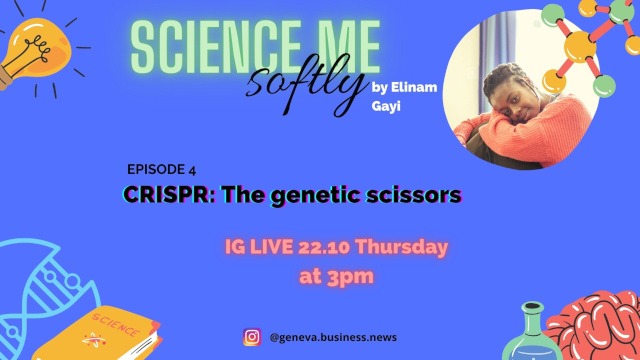
Thursday 22 October at 15.00, our resident scientist Elinam Gayi is hosing an IGLive talk on the genetic scissors or CRISPR. Elinam is a young scientist who takes scientific research and presents it in an interesting, engaging, and accessible way.
On the 7th of October this year, the Nobel prize in Chemistry was awarded to Emmanuelle Charpentier and Jennifer A. Doudna for the development of a method for genome editing. This method is called CRISPR. And now everyone wants in! People are using it to try and make crops that are climate resilient; to engineer algae that can produce biofuel, and even to detect and treat COVID19!
So, what is this amazing technology, how is it currently being used and what are the implications for the future?
Just like us, bacteria can be infected by viruses. However, some bacteria have evolved to defend themselves against such infections using the CRISPR system.
This system allows them to cut the DNA of viruses. Much like our own immune system, CRISPR allows bacteria to keep a memory of viruses that have previously invaded them. The bacteria then keep these memories in the form of snippets of DNA that, in the future, allow them to specifically detect, recognise, and destroy the DNA of invading viruses. In other words, it is similar to the way our bodies produce antibodies.
Charpentier and Doudna were able to recreate these “genetic scissors” in a test tube and prove that they could be programmed to cut DNA at any given site.
The applications of CRISPR technology are vast. It can not only be used to cure genetic diseases and prevent the spread of transmissible ones, but it can also be used in the agricultural and food industries to increase production and make crops drought-resistant. With such a wide range of applications, there are many technical and ethical concerns when it comes to the use of this technology.
Using CRISPR we now have the ability to modify our genome. But, where do we draw the line between therapy and enhancement? And what will be the implications for future generations?
For a live discussion on CRISPR, visit us on Instagram @geneva.business.news Thursday 22 October.
Further reading:
Blood diagnosis: A new tool against cancer by
The use of recreational drugs in therapy
References:
https://www.livescience.com/58790-crispr-explained.html
Press release: The Nobel Prize in Chemistry 2020. NobelPrize.org. Nobel Media AB 2020. Tue. 20 Oct 2020. https://www.nobelprize.org/prizes/chemistry/2020/press-release/
https://www.yourgenome.org/facts/what-is-crispr-cas9
https://www.yourgenome.org/facts/what-is-a-genome
https://www.wired.com/story/wired-guide-to-crispr/
https://www.technologyreview.com/2019/12/03/65024/crispr-baby-twins-lulu-and-nana-what-happened/