Social media and books: answering the siren call
In this article we analyse and even admire the overall impact of social networks on our book consumption... En lire plus

Against the voices of contestation, the American libraries must adapt to a new wave of change. But how can they remain inclusive when censorship is growing every day?
Amanda Jones was a librarian like any other until her life took a drastic turn in July 2022, after a meeting of the Livingston Parish Public Library Board in Louisiana. Her speech against censorship and for inclusive libraries led to a huge number of hateful messages on social media, some of them even containing death threats.
Attacked by conservative political figures, and in particular by Michael Lunsford, Amanda Jones became a victim of defamation. What was her supposed crime? She was allegedly exposing children to pornography, as stated by the Citizens for a New Louisiana committee on its website. After filing a defamation lawsuit, Amanda Jones’s case was unfortunately dismissed.
Having become a leading figure in the fight against literary censorship, Amanda Jones is now the Executive Director of the Livingston Parish Library Alliance, a group of local citizens dedicated to preserving library freedom to provide services to all users.
She is also a co-founding member of Louisiana Citizens Against Censorship, a popular organization fighting censorship in Louisiana. Amanda Jones’s first book That Librarian: Fighting Book Banner in Today’s America was published in August 2024.
Among the many professional organization dedicated to defending books and intellectual freedom, the American Library Association (ALA), founded in 1876 and based in Chicago, stands out.
One of ALA’s foundational ethical texts, the “Library Bill of Rights” and the “Freedom to Read Statement”, clearly establish the rights of libraries and readers to have unrestricted access to documents in all formats (paper or digital).
Unfortunately, Amanda Jones’s case is not isolated. Like her, dozens of other librarians in the United States suffer defamation, insults and threats on social media.
Numerous online resources allow librarians and booksellers to follow a professional code of conduct and protect themselves against demands for book removal and certain user behavior.
In its guide “How to respond to challenges and concerns about library resources?”, the ALA also reminds that parents have the right and responsibility to guide their own children’s reading, but they do not have the right to dictate what other parents can or cannot access.
Similarly, the PEN America association also offers a list of resources for students, authors, and educators on its website.
Initially established in 1982, Banned Books Week is an annual international event bringing together the book community to mobilize and raise awareness around censorship.
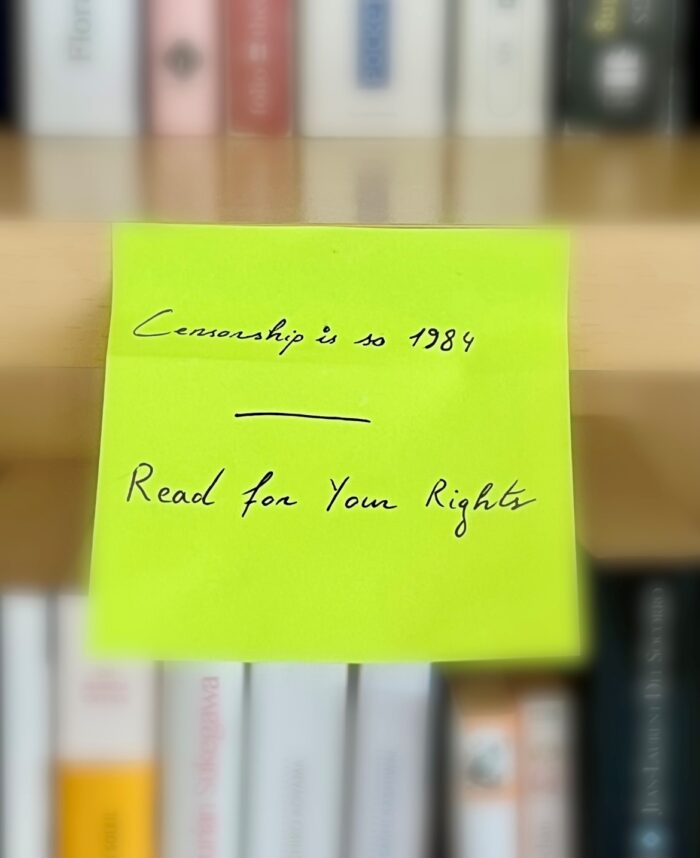
Censorship is so 1984. Read for your rights” is the theme chosen for the 2025 edition, which will take place from October 5 to 11, 2025. Since 2011, the American Association of School Librarians (AASL) has designated the Wednesday of Banned Book Week as “Banned Website Awareness Day”.
“The 2025 Banned Books Week theme reminds us that censorship efforts continue today. We must always come together to defend the right to read”, explains Cindy Hohl, ALA President.
On an international level, the PEN World Voices Festival took place from April 30 to May 3. Bringing together more than a hundred authors from thirty-five different countries, “this gathering powerfully reminds us – and is even an antidote in an era of censorship – that books drive culture and identity, while empowering and transforming our lives.”
American libraries and bookstores regularly set up dedicated sections for banned books on their shelves, encouraging users and readers to browse them, read them and, after all why not, borrow or buy them.
Peaceful demonstrations and marches are regularly organized across the country to advocate for the freedom of readers and libraries.
It’s also possible to imagine “out-of-the-box” actions, such as temporary installations in parks, squares, or any other public space, as well as collaborations with other cultural venues like museums or cultural centers, to raise public awareness about the consequences of book censorship.
The “Amanda Jones” case clearly demonstrates that library control and the resulting censorship are easily exploited politically to gain an advantage by playing on moral panic, especially among parents and conservative citizens.
Faced with the rise of literary censorship, American librarians find themselves on the front lines of a battle for intellectual freedom. Despite the pressures, threats, and defamation they endure, they can rely on strong professional organizations, clear policies, and citizen initiatives to defend free access to information.
Collective mobilization, illustrated by events like Banned Books Week and grassroots actions, reminds us that preserving our reading rights remains a fundamental democratic issue requiring constant vigilance.
In the next chapter, we will explore concrete examples of local or state political decisions implemented to both justify and counter literary censorship in the United States.
Réseaux sociaux et livres : céder aux chants des sirènes
Social media and books: answering the siren call
Prohibited from reading? Chapter three: how can American libraries remain inclusive ?
Interdit de lire ? Chapitre 3 : comment les bibliothèques américaines restent-elles inclusives ?
Prohibited from reading? Chapter 2: Voices of protest in the United States
Interdit de lire ? Chapitre 2 : Les voix de la contestation aux États-Unis
Prohibited from reading? Chapter one: a librarian analysis
Rencontre avec Tamar Songhulashvili : Un engagement pour l'intégration
L’intelligence artificielle au cœur de l’évolution du journalisme : débats et perspectives
Interdit de lire ? Chapitre 1 : décryptage d’une bibliothécair
Photo credit: Chloé Wahl
Dès mon plus jeune âge, les livres m'ont ouvert des fenêtres sur le monde. Chaque page tournée était une nouvelle aventure, chaque histoire m'a aidée à construire mon imagination et mon esprit critique. Cette fascination pour le monde des livres m'a naturellement menée vers ma vocation, devenir agente en information documentaire. Mon but est de continuer à connecter les gens avec les bons livres et les bonnes ressources numériques. Il me tient également à cœur de rester engagée dans la mission primordiale des bibliothèques : promouvoir l'accès à la culture pour tous les publics malgré les nombreux défis qui s'imposent.